
Pull to refresh
Logo
Seed-sized injectable device wirelessly stimulates nerves for chronic pain

Seed-sized injectable device wirelessly stimulates nerves for chronic pain

New Capabilities

NYU Abu Dhabi and Cleveland Clinic Abu Dhabi show battery-free nerve stimulation without surgery in early animal testing

Today: ScienceDaily reports on injectable nerve stimulator

Overview

Updated 1 hour ago

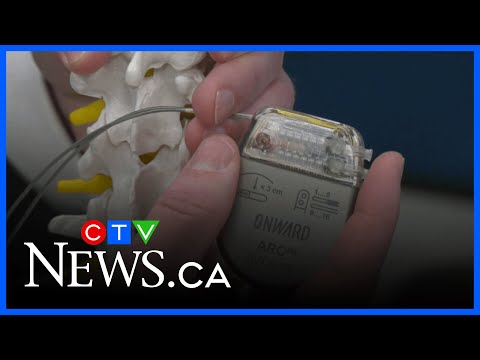
Treating chronic pain with electrical nerve stimulation has meant surgery for decades. A surgeon opens the body, places leads on millimeter-scale nerves, and implants a battery pack under the skin. Researchers at NYU Abu Dhabi, working with Cleveland Clinic Abu Dhabi, have now shown a seed-sized device that goes in through a standard needle instead.

The implant needs no battery and no wires. A small transmitter worn on the skin powers it wirelessly through the tissue, and the device converts that energy into programmable electrical pulses that modulate nerve activity. In rat experiments published in Science Advances, it produced leg-twitch responses at the applied stimulation frequency, and researchers adjusted intensity in real time from outside the body.

The technology remains in early stages. It has not been tested in humans, and the team cannot yet say whether it will relieve chronic pain in people. A separate University of Florida group, funded by a National Institutes of Health grant, is developing a similar injectable implant.

Why it matters

If the approach proves safe in humans, chronic pain treatment could shift from surgical implantation to a single injection, expanding access to nerve stimulation therapy.

Questions about this story

Free account needed to ask — your question is kept and asked for you right after sign-up. Answers are public.

No questions yet — be the first to ask.

Key Indicators

$1.5M
NIH grant for parallel University of Florida research
National Institutes of Health grant awarded in 2024 to Adam Khalifa for injectable, battery-free implant development.
Seed-sized
Device size
The implant is roughly the size of a small seed and fits through a standard injection needle.
Science Advances 12(24)
Peer-reviewed publication
Study published in Science Advances, volume 12, issue 24, in 2026.

Voices

Curated perspectives — historical figures and your fellow readers.

Ever wondered what historical figures would say about today's headlines?

Sign up to generate historical perspectives on this story.

People Involved

Organizations Involved

Timeline

2024 October 2026

4 events Latest: Today
Tap a bar to jump to that date
  1. ScienceDaily reports on injectable nerve stimulator

    Today Reporting

    ScienceDaily publishes a report on the NYU Abu Dhabi study, bringing the research to wide public attention.

  2. NYU Abu Dhabi study published in Science Advances

    Publication

    Study describing a seed-sized, injectable, wirelessly powered nerve stimulator appears in Science Advances, volume 12, issue 24.

  3. University of Florida demonstrates injectable stimulator in rats

    Research

    Khalifa's team shows its injectable implant can wirelessly activate sciatic nerves in rats and produce muscle responses.

  4. NIH funds University of Florida injectable implant research

    Funding

    National Institutes of Health awards $1.5 million to Adam Khalifa to develop battery-free, injectable microchips for nerve stimulation.

Scenarios

1

Injectable nerve stimulator enters first human trials

Likely Resolves by End of 2028

Discussed by: Researchers at both NYU Abu Dhabi and University of Florida have stated the next step is large-animal or human testing. Khalifa said his team is working to shrink the device by half for human use.

Either research team completes large-animal safety studies, shrinks its device to the target size, and gains regulatory clearance for a first-in-human study. The NYU Abu Dhabi team plans to use ultrasound and CT imaging to guide placement, which may simplify the approval path.

2

Long-term safety data stalls injectable nerve stimulator development

Possible Resolves by End of 2027

Discussed by: The NYU Abu Dhabi team acknowledged the device's ability to relieve chronic pain in humans is unproven. The research community will need months-long biocompatibility and stability data before any human testing.

The device shifts position, degrades, or causes tissue reactions in long-term animal studies. Researchers would need to redesign components, the delivery method, or the external transmitter, pushing human trials back several years.

3

University of Florida's rival injectable implant reaches clinical testing first

Possible Resolves by Q2 2029

Discussed by: The University of Florida team has NIH funding and has stated the next step is human testing. Their device uses a wearable transmitter smaller than a baseball card, which patients can remove when not needed.

Khalifa's team moves faster through pre-clinical validation because of its NIH funding head start and its stated focus on reducing size for human trials. A UF-led first-in-human study would make the University of Florida the first to test the approach in people.

Historical Context

2 moments from history that rhyme with this story — and how they unfolded.

1958-1969

Implantable pacemaker (1958-1960s)

The first fully implantable pacemaker went into a Swedish patient in 1958. It required opening the chest cavity. Within a decade, engineers shrank the devices enough that implantation became routine, cementing surgery as the standard for putting electronics inside the body.

Then

Pacemaker implantation became a standard surgical procedure worldwide.

Now

Established the model of surgically implanted medical electronics that persists today for most implantable devices.

Why this matters now

The pacemaker showed that electrical devices can safely live inside the body. It also locked in the assumption that getting them there requires surgery. This new device challenges that assumption.

1967-present

Spinal cord stimulation for chronic pain (1967-present)

Researchers first demonstrated spinal cord stimulation for chronic pain in 1967. The technique works for many patients, but implanting the leads requires surgery with associated risks and weeks of recovery. Modern systems use surgically implanted leads connected to battery packs under the skin.

Then

Spinal cord stimulators became a standard treatment for refractory chronic pain.

Now

Showed electrical nerve stimulation is clinically effective, while making surgical implantation the accepted delivery method.

Why this matters now

Spinal cord stimulation is the closest existing analog to what the injectable device does. It demonstrates the therapeutic promise of nerve stimulation and the clinical burden this new technology seeks to remove.

Sources

(5)