



Pull to refresh
Logo
Cascadia subduction zone is tearing apart off Vancouver Island

Cascadia subduction zone is tearing apart off Vancouver Island

New Capabilities

Scientists capture a tectonic plate fragmenting piece by piece beneath the Pacific Northwest

Today: Study documents Cascadia slab tearing

Overview

Updated 1 hour ago

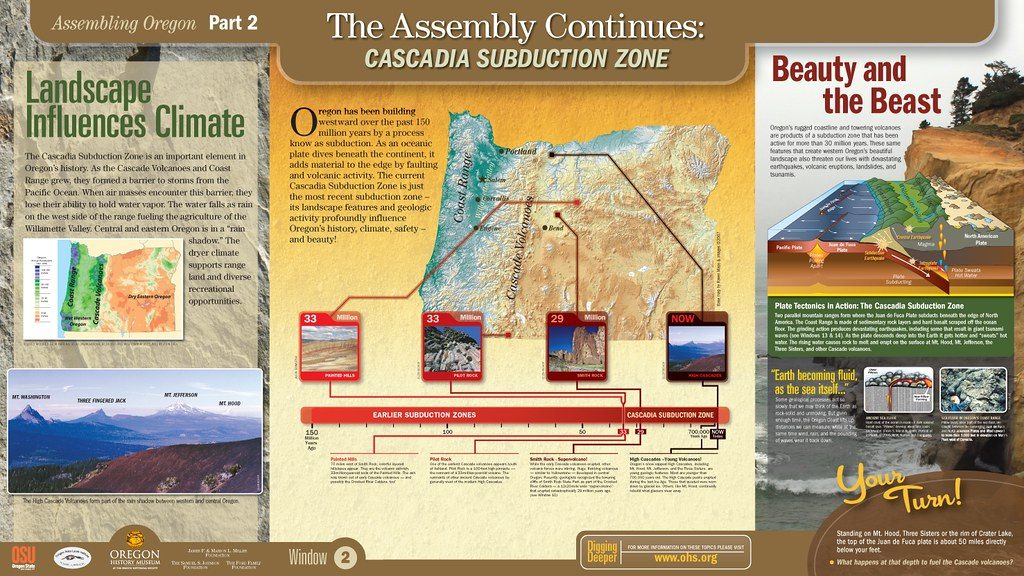
Scientists have watched a tectonic plate off Vancouver Island tearing itself apart. The Juan de Fuca plate, sliding beneath North America along the Cascadia subduction zone, is fragmenting piece by piece rather than failing all at once.

The discovery, published in Science Advances, shows how subduction systems die and helps explain ancient plate fragments and volcanic patterns. It also maps hidden breaks that could influence how the next great Cascadia earthquake ruptures, though it does not change near-term hazard.

Why it matters

The tears beneath Cascadia could redirect how the region's next great earthquake ruptures and where volcanic activity concentrates over geologic time.

Questions about this story

Free account needed to ask — your question is kept and asked for you right after sign-up. Answers are public.

No questions yet — be the first to ask.

Key Indicators

75 km
Length of the main tear
A tear where the slab drops about 5 km; earthquakes continue on one side but have gone quiet on the other.
12 mi
Width of the Nootka transform corridor
A broad shear zone narrowed into a focused ~12-mile corridor that severed the Explorer microplate.
0.8 in/yr
Explorer plate subduction speed
The torn Explorer side slowed to ~0.8 in/yr while Juan de Fuca continues at ~1.6 in/yr.
4 million years
Age of the initiating shear zone
The shear zone that became the Nootka transform began forming about 4 million years ago.
47 mi
Projected margin shortening
The subduction margin is expected to shorten by ~47 miles once the Explorer segment is captured by the Pacific plate.

Voices

Curated perspectives — historical figures and your fellow readers.

Ever wondered what historical figures would say about today's headlines?

Sign up to generate historical perspectives on this story.

People Involved

Organizations Involved

Timeline

September 2026 ~4 Ma

2 events Latest: Today
  1. Shear zone forms off Vancouver Island

    Upcoming Background

    A broad shear zone develops as the ridge approaches the Cascadia trench, exploiting ridge-parallel fabrics of young oceanic lithosphere.

  2. Study documents Cascadia slab tearing

    Today Discovery

    LSU researchers publish seismic imaging showing the Juan de Fuca slab fragmenting off Vancouver Island, with tears offset by the Nootka transform boundary.

Scenarios

1

Cascadia hazard models adopt the slab tears

Possible Resolves by End of 2028

Discussed by: USGS and Cascadia earthquake researchers

The paper's authors say the tears could affect how a future megathrust rupture propagates. If follow-up modeling shows the breaks redirect or stop ruptures, official hazard models would need revision. The tears don't change near-term risk, but they sharpen maps of which parts of the slab are attached and where stresses concentrate.

2

Slab window detected beneath the margin

Possible Resolves by End of 2030

Discussed by: Paper authors and mantle geophysicists

When the tear finishes cutting through the descending slab, a gap called a slab window opens. Hotter mantle can rise through it, altering heat flow and melting patterns. Follow-up seismic imaging would detect the upwelling directly, and volcanic geochemistry could shift over geologic time.

3

Piecewise termination model spreads to other subduction zones

Likely Resolves by End of 2031

Discussed by: Tectonics researchers

The paper proposes that subduction zones end through a series of smaller breakups rather than one event. If geologists find similar tearing patterns at other margins or in the ancient plate record, the transform-driven model becomes a standard explanation for how subduction terminates. The authors note fossil microplates left behind by the Farallon plate already hint at this process.

Historical Context

3 moments from history that rhyme with this story — and how they unfolded.

January 1700

1700 Cascadia megathrust earthquake

The last great rupture of the Cascadia margin, estimated at magnitude 8.7 to 9.2, produced a tsunami recorded in Japanese chronicles and preserved in Native American oral histories.

Then

The coast subsided and a tsunami struck Japan's coast hours later.

Now

It established that Cascadia produces giant earthquakes, driving modern hazard assessment of the region.

Why this matters now

The newly mapped tears could one day influence how such a rupture propagates along the margin.

2002–2005

Discovery of episodic tremor and slip (2002–2005)

Researchers found that Cascadia undergoes periodic slow-slip events and tremor, releasing stress gradually instead of in a single rupture.

Then

The discovery changed how scientists modeled strain accumulation on the megathrust.

Now

It deepened understanding of the margin's behavior without altering its long-term hazard.

Why this matters now

Like today's slab tears, it refined models of the fault system while leaving near-term risk unchanged.

100 Ma to present

Farallon plate fragmentation (Cretaceous–Cenozoic)

The enormous Farallon plate, which once covered much of the eastern Pacific, broke into the Juan de Fuca, Cocos, and Nazca plates as the Pacific-Farallon ridge approached the North American trench. Geologists have found fossil microplates it left behind.

Then

New plate boundaries formed as segments detached at different times.

Now

The fragments became today's active oceanic plates, including the one now tearing apart off Vancouver Island.

Why this matters now

The paper cites these fossil microplates as evidence that subduction systems break apart in pieces. Cascadia now shows the process happening live.

Sources

(10)