

Pull to refresh
Logo
Canada and EU launch Alliance for the Future, name Canada first 'associate member'

Canada and EU launch Alliance for the Future, name Canada first 'associate member'

Rule Changes

A digital trade deal, a minerals lending framework and a €500m Ukraine contribution sit inside a partnership that stops short of membership

Overview

Updated 1 hour ago

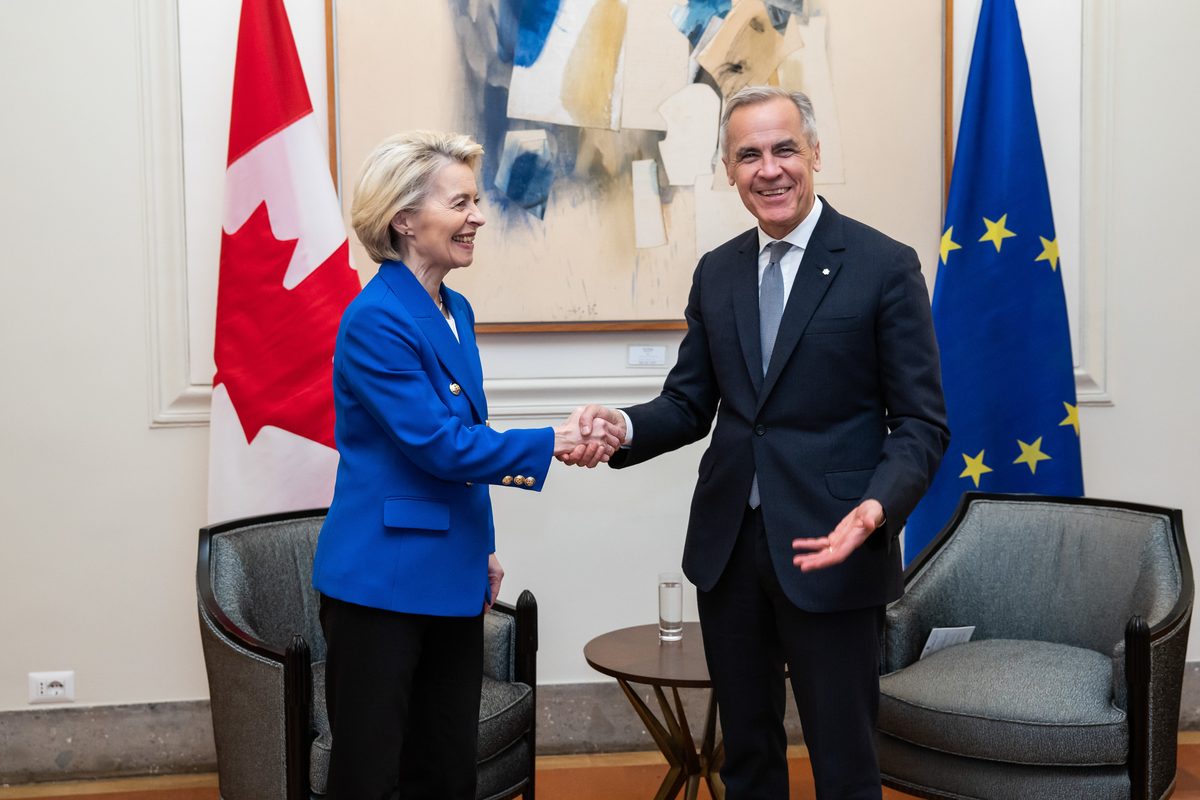
Canada and the European Union closed a two-day summit in Montreal on Oct. 30 by launching an "Alliance for the Future" and declaring Canada the bloc's first "associate member." The phrase has no legal basis in EU law and is contested by some member states. What does have text is a concluded Digital Trade Agreement, a lending framework for Canadian critical minerals, and Canada's entry into the EU's support loan for Ukraine.

The pressure behind the move is Washington. Before US tariffs upended the relationship, Canada sent nearly 80% of its exports south. In August, talks broke down and Trump imposed a 50% levy on $20bn of Canadian goods. Ottawa is now building a second economic perimeter, and Brussels is buying access to minerals it currently sources largely from China.

Why it matters

If the association hardens, Canada becomes the template for how US allies hedge against Washington without formally joining anything.

Questions about this story

Free account needed to ask — your question is kept and asked for you right after sign-up. Answers are public.

No questions yet — be the first to ask.

Key Indicators

80%
Share of Canadian exports sent to the US
The pre-tariff baseline that made Canada vulnerable to a single market.
50%
US levy on $20bn of Canadian goods
Imposed in August after trade talks broke down; Canada retaliated with matching tariffs.
20+
Measures announced at the summit
Carney's figure for the package agreed in Montreal.
6
Cooperation areas in the alliance
Trade, digital and research, critical resources and energy, financial services, security, and people-to-people ties.
€500M
Canada's initial contribution to the EU's Ukraine loan
Part of a €90bn EU support loan for Kyiv that Canada is joining.

Voices

Curated perspectives — historical figures and your fellow readers.

Sign up to generate historical perspectives on this story.

People Involved

Organizations Involved

Timeline

2017 October 2026

8 events Latest: 2 days ago
Tap a bar to jump to that date
  1. Alliance for the Future launched

    Latest Summit

    Leaders announce six cooperation areas and a goal of defining an ever-closer association by 2027.

  2. Digital Trade Agreement negotiations concluded

    Trade

    Text agreed on cross-border data flows, e-contracts and online consumer protection; ratification remains.

  3. EIB opens lending route to Canadian minerals

    Finance

    Framework agreement signed; no specific projects funded yet.

  4. Canada joins EU's Ukraine loan

    Aid

    Initial contribution of €500m toward the EU's €90bn support loan for Kyiv.

  5. EU-Canada summit opens in Montreal

    Summit

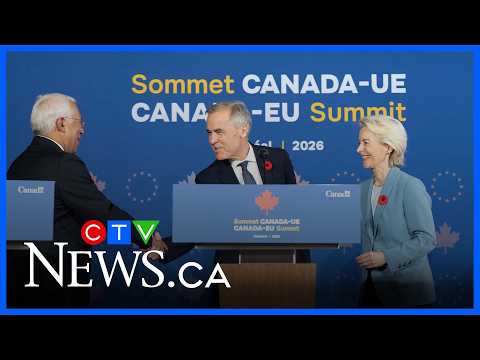
    Carney hosts von der Leyen and Costa for the 21st EU-Canada summit.

  6. US-Canada trade talks collapse

    Tariff

    Trump imposes a 50% levy on $20bn of Canadian goods; Ottawa retaliates in kind.

  7. Digital trade talks begin

    Trade

    Negotiations launched at the fifth CETA Joint Committee meeting.

  8. CETA takes provisional effect

    Trade

    The EU-Canada free trade agreement begins provisional application, cutting most tariffs without full ratification.

Scenarios

1

Canada formally designated the EU's first associate member

Possible Resolves by End of 2027

Discussed by: Carney and the European Council, which set a 2027 target for defining the concept

Both sides have committed to define an "ever-closer association of Canada to the EU, short of full membership" by the 2027 EU-Canada summit. If that definition includes a formal associate designation, Canada becomes the first country outside Europe's neighbourhood to hold the label. The obstacle is the member states that reject the framing as having no legal basis.

2

Digital Trade Agreement clears ratification and enters into force

Likely Resolves by End of 2028

Discussed by: The European Commission, which called the conclusion of talks a landmark step

Negotiations are done, but the text now needs legal scrubbing, translation into all EU languages, Council approval and a European Parliament vote. Canada has its own process. The deal would lock in rules on cross-border data flows, e-signatures and online consumer protection that sit on top of CETA.

3

US-Canada deal defuses the pivot before associate status lands

Uncertain Resolves by Q2 2027

Discussed by: Al Jazeera, which reported that Carney and Trump have talks under way toward a deal

Trump's tariffs created the urgency in Montreal. If Washington and Ottawa reach a trade agreement that removes the 50% levy, the political case for pushing past a declaratory alliance weakens. Canada would keep the EU package but stop short of the institutional commitments associate status implies.

Historical Context

3 moments from history that rhyme with this story — and how they unfolded.

2016-2017

CETA negotiations and the Wallonia block (2016)

The EU and Canada finished negotiating a comprehensive free trade agreement, then nearly lost it. Belgium's Walloon regional parliament withheld approval, holding up the EU's signature for days. The deal was saved by adding interpretive declarations.

Then

CETA was signed in October 2016 and began provisional application in September 2017.

Now

Most of the agreement still awaits full ratification by all EU national parliaments, a decade later.

Why this matters now

The Digital Trade Agreement signed in Montreal faces the same gauntlet: national parliaments, regions and translation. Concluding talks is the start of the EU process, not the end.

1963

The EU-Turkey Ankara Agreement (1963)

The European Economic Community and Turkey signed an association agreement that envisaged eventual membership and created a customs union, which took effect in 1995. It was the deepest relationship the bloc had offered a non-member.

Then

Turkey received tariff-free access to the EU market for industrial goods without becoming a member.

Now

Accession talks opened in 2005 and stalled; the association framework outlasted the membership path it was meant to lead to.

Why this matters now

It shows how an "association" tier can become permanent rather than transitional. Canada's associate label may settle as a stable status rather than a waiting room.

2014-2021

Switzerland's collapsed framework agreement (2021)

The EU and Switzerland spent years negotiating an institutional framework to replace a patchwork of bilateral treaties. Bern walked away from the draft in May 2021, citing sovereignty and immigration concerns.

Then

Swiss access to EU research programmes lapsed and the relationship was left on its old legal basis.

Now

The EU has since insisted that new market access comes with a single institutional framework, tightening terms for non-members.

Why this matters now

It is the cautionary precedent: a close non-member relationship can stall for years on sovereignty terms, and the EU's terms have only gotten firmer since.

Sources

(8)