
Pull to refresh
Logo
Big Ring of galaxies spans 1.3 billion light-years, beyond cosmology's expected limit

Big Ring of galaxies spans 1.3 billion light-years, beyond cosmology's expected limit

New Capabilities

Two ultra-large structures sit in the same patch of sky, and neither fits the standard picture

Overview

Updated 35 minutes ago

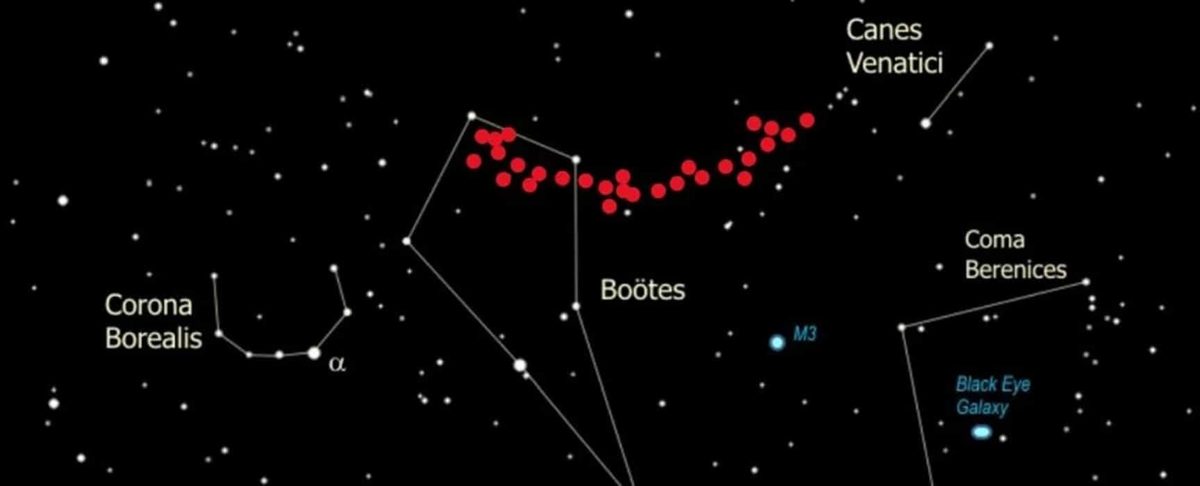
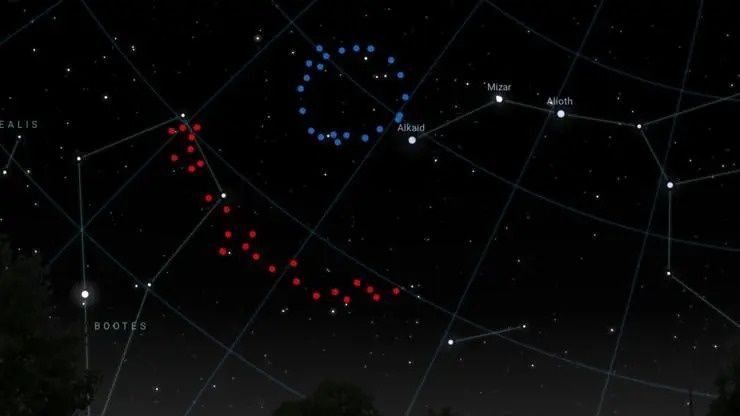
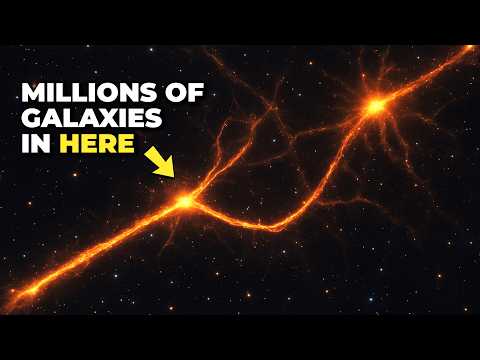
In January 2024, Alexia Lopez told a meeting of the American Astronomical Society that her team had found a ring of galaxies 1.3 billion light-years across. It sits at the same distance and in the same patch of sky as an arc her team first reported in 2021.

Both structures are larger than the roughly 1.2-billion-light-year ceiling cosmology sets on clumps of matter. If they are real, the assumption that the universe looks the same in every direction at large scales needs revising. If they are chance alignments, the standard model holds.

Why it matters

If the cosmological principle needs amending, the standard model that predicts cosmic expansion, dark energy and galaxy formation rests on shakier ground.

Questions about this story

Free account needed to ask — your question is kept and asked for you right after sign-up. Answers are public.

No questions yet — be the first to ask.

Key Indicators

1.3 billion light-years
Big Ring diameter
About 400 megaparsecs at the present epoch, per the discovery paper.
5.2σ
Peak departure from a random field
The annulus and inner absorbers measured against a control field using the Convex Hull of Member Spheres method.
12°
Sky separation between Big Ring and Giant Arc
Both sit at redshift 0.8, roughly 6.9 billion light-years away in light-travel time.
1.2 billion light-years
Theoretical size limit cosmology allows
The ceiling Lopez cites for the largest structure the standard model permits.
2
Ultra-large structures in the same region
The Big Ring and the Giant Arc.

Voices

Curated perspectives — historical figures and your fellow readers.

Sign up to generate historical perspectives on this story.

People Involved

Organizations Involved

Timeline

June 2021 November 2026

7 events Latest: Today
Tap a bar to jump to that date
  1. ScienceAlert publishes feature on the pair

    Today Publication

    The article restates the 2024 finding and the two leading alternative explanations: cosmic strings and conformal cyclic cosmology.

  2. Follow-up paper weighs explanations

    Publication

    A review argues a baryon acoustic oscillation origin is probably ruled out and treats cosmic strings as an open possibility.

  3. Big Ring preprint posted

    Publication

    The paper reports a departure from random expectation of up to 5.2 sigma and notes the ring is larger than a baryon acoustic oscillation.

  4. Big Ring presented

    Conference

    Lopez tells the American Astronomical Society's New Orleans meeting that a 1.3-billion-light-year ring sits beside the Giant Arc.

  5. Big Ring peer-reviewed

    Publication

    The study is published in the Journal of Cosmology and Astroparticle Physics.

  6. Giant Arc study published

    Publication

    The paper appears in Monthly Notices of the Royal Astronomical Society, reporting clustering signatures between 3.0 and 4.8 sigma depending on the method.

  7. Giant Arc announced

    Discovery

    Lopez's team reports an arc of galaxies about 1 gigaparsec across, traced through magnesium absorbers in quasar spectra.

Scenarios

1

Spectroscopy confirms the Big Ring as a three-dimensional structure

Possible Resolves by Q2 2029

Discussed by: Lopez and co-authors in the discovery paper and its follow-up, which flag that the ring is traced by intervening absorbers rather than individually measured galaxy distances

The current result rests on statistical clustering of gas clouds along quasar sightlines. Measuring redshifts for individual galaxies or absorbers across the ring would show whether the shape holds in three dimensions or dissolves into a foreground-background projection. Confirmation would force the size question.

2

Reanalysis finds both structures are chance alignments

Uncertain Resolves by End of 2028

Discussed by: Lopez's own 2024 review, which notes that extreme-value analysis and cosmological simulations can accommodate some individual ultra-large structures within the standard model

A large enough survey will always throw up odd-looking clumps somewhere. If a reanalysis shows the ring and arc overdensities fall within what random fluctuations produce at this survey volume, no new physics is needed and the cosmological principle survives intact.

3

A third ultra-large structure turns up beside the first two

Possible Resolves by End of 2030

Discussed by: Lopez, who said the best hope is finding more such arrangements scattered through the sky

One unusual structure can be a fluke. Two at the same redshift and 12 degrees apart already strain that reading. A third in the same region would make the case that these are a connected system, and would shift the argument from statistics toward something cosmology has to name.

Historical Context

3 moments from history that rhyme with this story — and how they unfolded.

1991

Clowes-Campusano Large Quasar Group (1991)

Roger Clowes and Luis Campusano reported a grouping of quasars spanning roughly 580 megaparsecs, far wider than the scale at which the universe was supposed to even out. Quasar surveys were sparse, and the grouping was built from relatively few objects.

Then

It became a standard citation for the idea that the largest structures might exceed what the standard model allows.

Now

The result stood but never displaced the standard model; the same question of whether an apparent clump is real or an artefact of the catalogue carried forward.

Why this matters now

Clowes is a co-author on both the Giant Arc and the Big Ring, so the current claim comes from the same lineage as the 1991 one.

2003

Sloan Great Wall (2003)

Astronomers using Sloan Digital Sky Survey data mapped a filament of galaxies more than a billion light-years long. It was the largest known structure at the time and was widely described as a possible problem for uniformity.

Then

It put large-scale structure and the cosmological principle back into general discussion.

Now

Later statistical work found structures this size rare but compatible with the standard model once the survey volume was accounted for.

Why this matters now

It set the template now being applied to the Big Ring: find the structure, then test whether random fluctuation could produce it.

2013

Hercules-Corona Borealis Great Wall (2013)

A team using gamma-ray bursts reported a structure roughly 10 billion light-years across, which would be far too large for the standard model to produce. The claim rested on how the bursts were distributed on the sky.

Then

It was widely cited as evidence that the cosmological principle might fail on the largest scales.

Now

Later analyses argued the grouping was an artefact of uneven burst sampling and sky exposure. It remains disputed rather than established.

Why this matters now

It shows how these claims get settled: by rechecking the catalogue and the statistics, not by repeating the size figure.

Sources

(7)