

Pull to refresh
Logo
Astronomers find a pair of giant quasars from the cosmic dawn

Astronomers find a pair of giant quasars from the cosmic dawn

New Capabilities

JWST and Gemini North spot the most distant compact quasar pair yet, 900 million years after the Big Bang.

Overview

Updated 1 hour ago

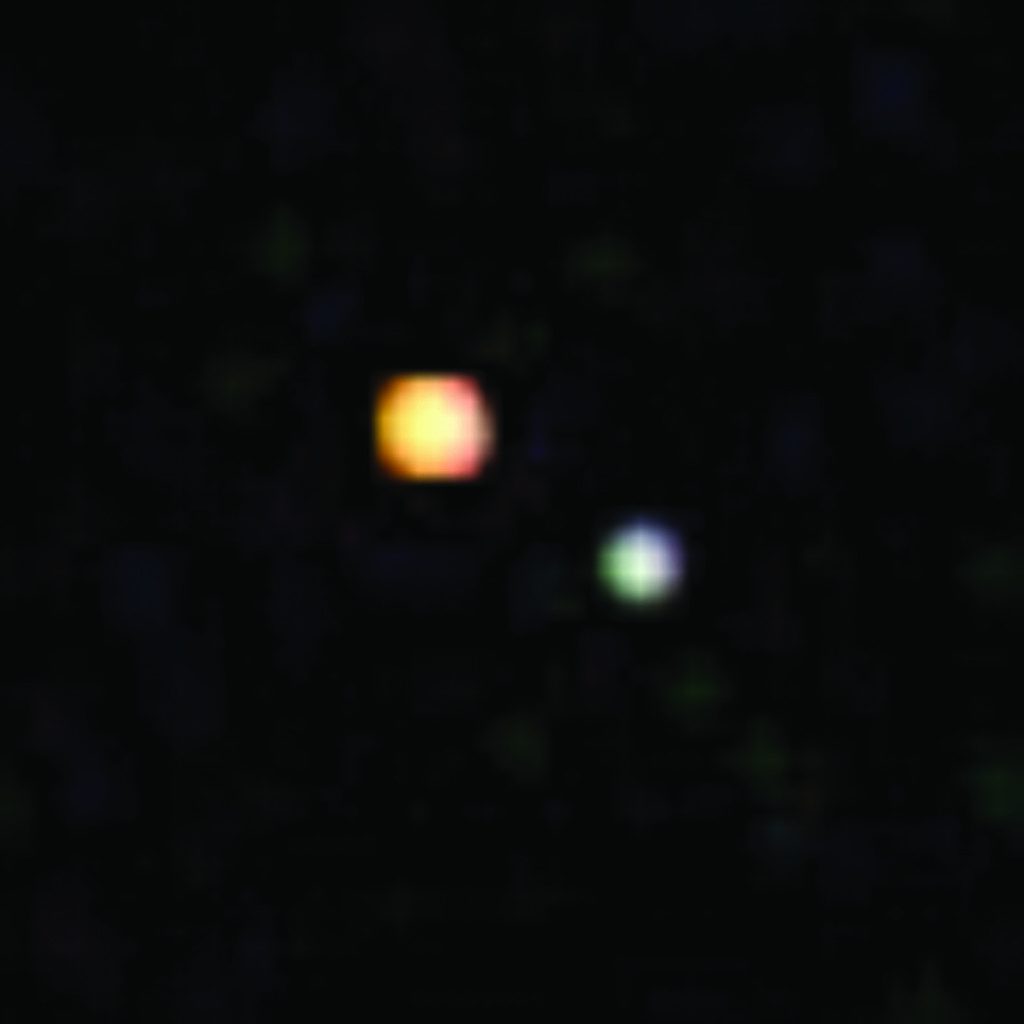
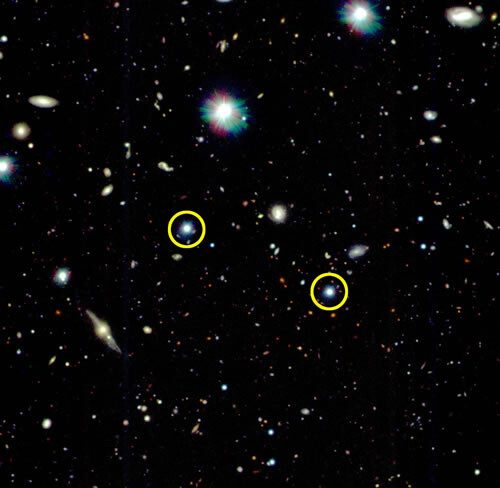
Astronomers have found two quasars burning in the same galaxy 900 million years after the Big Bang. The black holes powering them contain about 1.5 billion and 400 million times the Sun's mass, and the two sources sit only 18,100 light-years apart.

Quasars are bright cores of galaxies where gas falling onto a supermassive black hole heats up and outshines the surrounding stars. This pair, designated J1602+4228AB, is the most distant compact quasar pair yet seen and only the third known from cosmic dawn, when the first galaxies were forming.

Why it matters

If giant black holes could pair up this early, models of how the first galaxies assembled are missing a growth channel.

Questions about this story

Free account needed to ask — your question is kept and asked for you right after sign-up. Answers are public.

No questions yet — be the first to ask.

Key Indicators

2
Black holes in the system
J1602+4228A and B are both active quasars.
900 million
Years after the Big Bang
The universe was about one-thirteenth of its current age.
1.5 billion
Larger black hole mass, in Suns
The companion contains about 400 million solar masses.
18,100
Separation in light-years
About one-fifth the diameter of the Milky Way.
3
Known cosmic-dawn quasar pairs
This is the third such pair found in the early universe.

Voices

Curated perspectives — historical figures and your fellow readers.

Sign up to generate historical perspectives on this story.

People Involved

Organizations Involved

Timeline

2 events Latest: Today
  1. Nature reports the discovery

    Today Publication

    Nature's research highlight describes the rare pair of bright black holes gobbling gas less than one billion years after the Big Bang.

  2. Study reports most distant compact quasar pair

    Research

    The Astrophysical Journal Letters publishes the J1602+4228AB study. The pair is 900 million years after the Big Bang.

Scenarios

1

Aether survey finds more cosmic-dawn quasar pairs

Possible Resolves by End of 2027

Discussed by: Silvia Onorato and the Aether team

Onorato described the system as a laboratory for studying early galaxy interactions. If dense early regions commonly produce paired quasars, the Aether survey should turn up more.

2

Independent spectra confirm both objects are quasars at the same distance

Likely Resolves by Q2 2027

Discussed by: The discovery team, whose Gemini North follow-up separated the two sources

Gemini North resolved two distinct sources. Independent spectra are the usual next test. If both show quasar emission at the same redshift, the pair interpretation holds.

3

Theorists revise black-hole seed models to explain the pair

Possible Resolves by End of 2028

Discussed by: Silvia Onorato, who said there is no definitive theoretical explanation for even one such early quasar

Heavy seeds from direct gas collapse or sustained super-Eddington feeding are the main alternatives. The pair's two masses and tight separation give theorists a test case.

Historical Context

2 moments from history that rhyme with this story — and how they unfolded.

1963

3C 273 and the first quasar (1963)

Maarten Schmidt at Palomar Observatory measured the spectrum of 3C 273 and found a redshift of 0.158. That placed the object about 2.4 billion light-years away and meant it was far brighter than any galaxy known.

Then

Astronomers recognized quasars as distant, extremely luminous active galaxies.

Now

The black-hole accretion model became the standard explanation for quasar energy.

Why this matters now

J1602+4228AB are quasars: the same accretion mechanism, seen when the universe was less than a billion years old.

December 1995

Hubble Deep Field (1995)

Hubble Space Telescope stared at a tiny patch of sky for ten days, revealing thousands of distant galaxies. Some had existed when the universe was a fraction of its current age.

Then

The image showed that early galaxy assembly was common and that deep surveys could find distant objects.

Now

It set the template for later deep fields and for surveys that hunt early quasars.

Why this matters now

The Aether survey uses the same logic with JWST, scanning a large sample of early quasars for rare pairs.

Sources

(3)