


Pull to refresh
Logo
Daily Brief
Following
Why
The great doubling: human life expectancy over two centuries

The great doubling: human life expectancy over two centuries

New Capabilities
By Newzino Staff |

From 30 Years to 72: The Mechanisms Behind Humanity's Longest Survival Run

January 1st, 2023: Global Life Expectancy Reaches 72+ Years

Overview

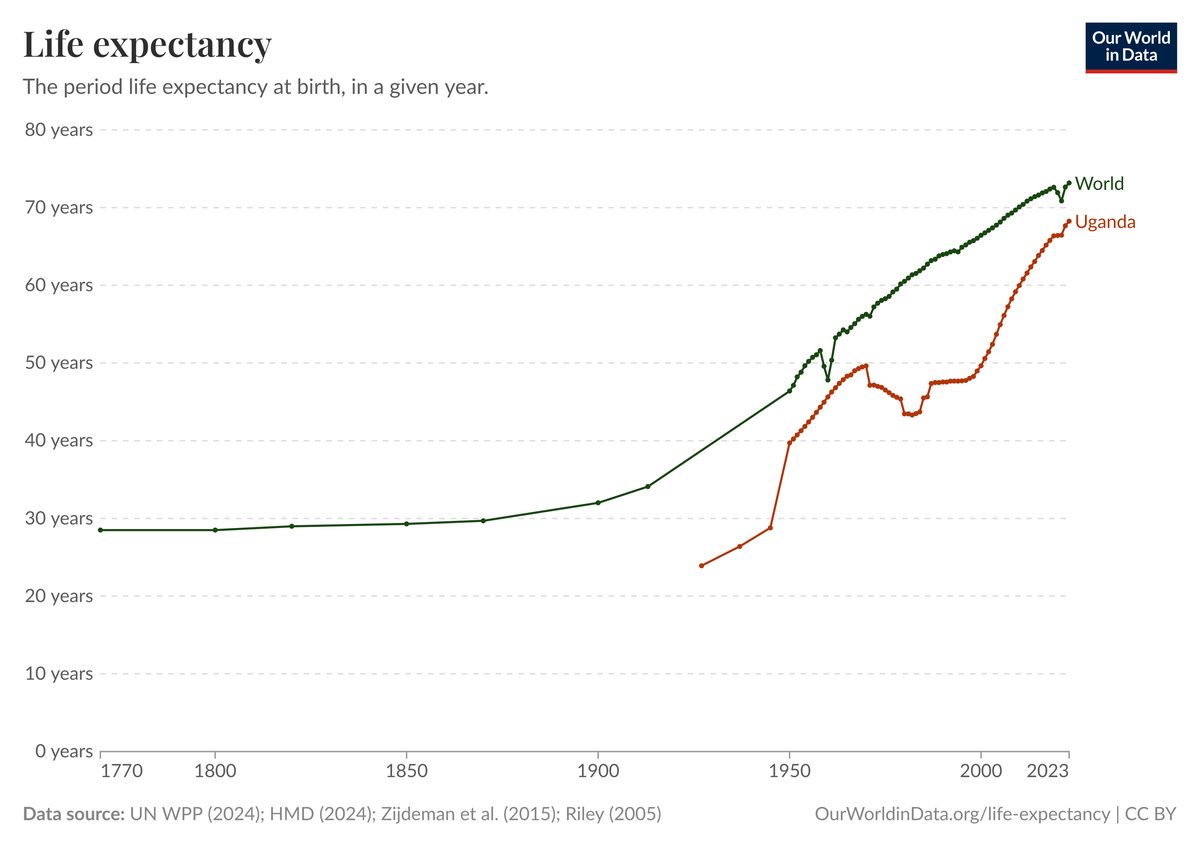
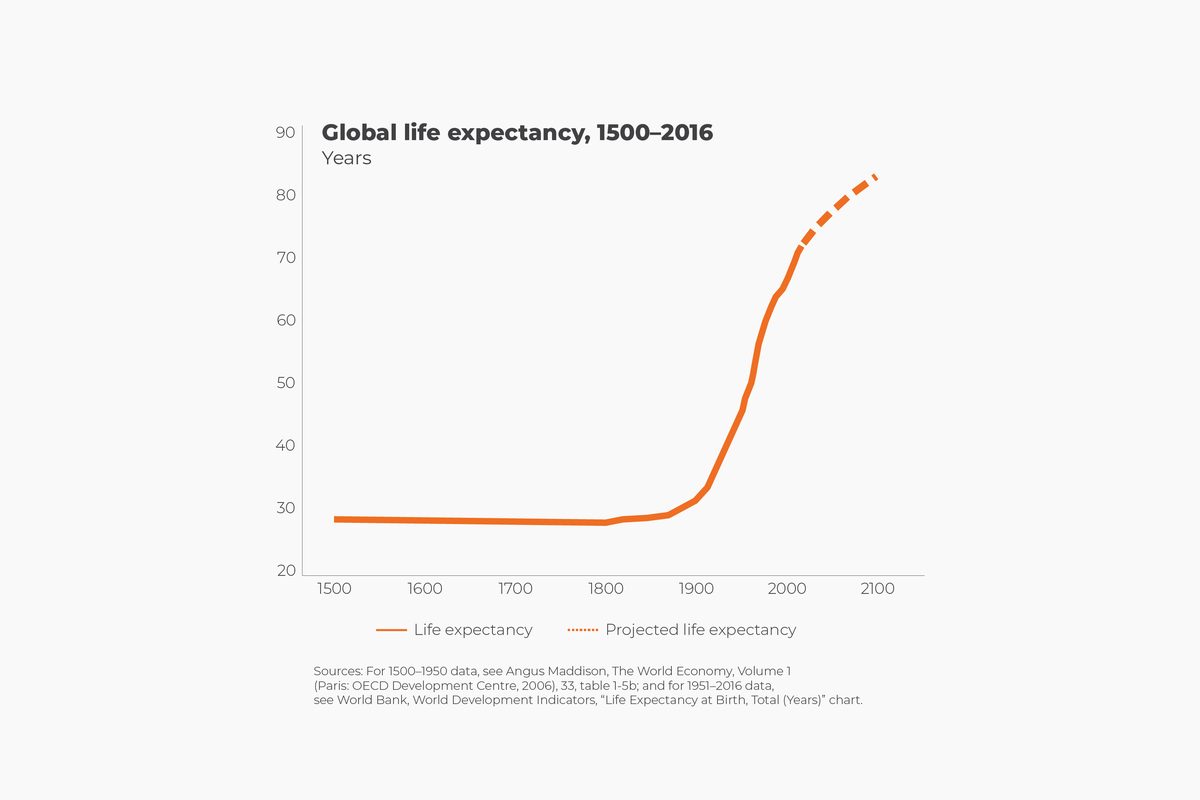
For most of human history, the average person could expect to live about 30 years. Two centuries of accumulated advances—clean water, sanitation, vaccines, antibiotics, nutrition, and poverty reduction—have more than doubled that figure to 72 years globally. The change is so comprehensive that the global average today exceeds what the healthiest country achieved in 1950.

This transformation is not solely about saving infants. Life expectancy has increased at every age, across every region. A century ago, India and South Korea had life expectancies around 23 years; today India's has nearly tripled and South Korea's has nearly quadrupled. The gap between the longest-lived and shortest-lived countries remains substantial—33 years separates Japan from Lesotho—but it is narrowing as the poorest regions make the fastest gains.

Key Indicators

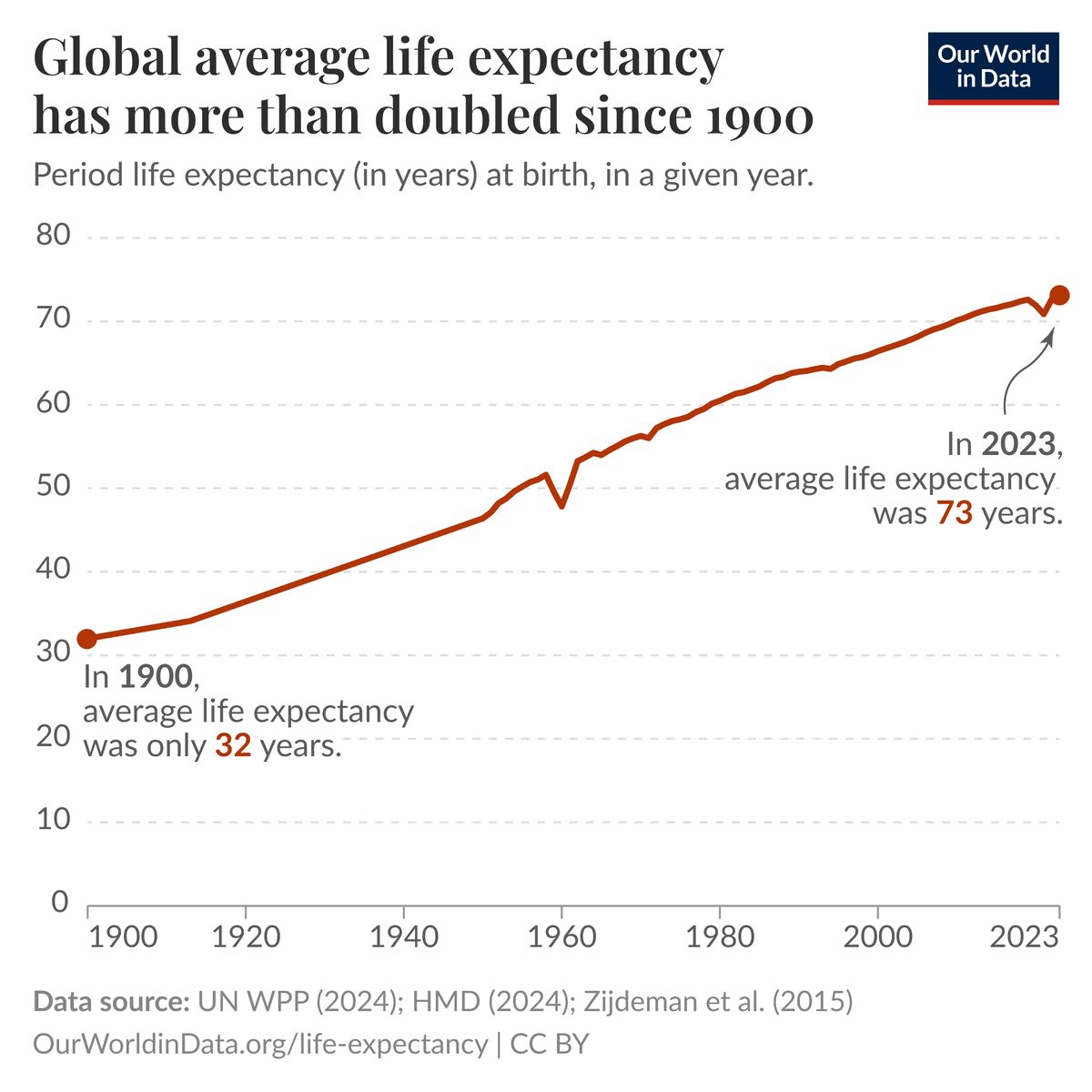
32 → 72
Global Life Expectancy (Years)
Average life expectancy at birth rose from 32 years in 1900 to over 72 years by 2023.
50% → 4%
Child Mortality Before Age 15
For most of history, roughly half of all children died before reaching 15. By 2020, that figure had fallen to 4%.
150 million
Children Saved by Vaccines (1974-2024)
Vaccines alone are estimated to have saved 150 million lives over the past 50 years.
33 years
Gap: Highest vs. Lowest Country
Japan's life expectancy of 84.5 years exceeds Lesotho's 51.5 years by more than three decades.

Interactive

Exploring all sides of a story is often best achieved with Play.

Ever wondered what historical figures would say about today's headlines?

Sign up to generate historical perspectives on this story.

Sign Up

Debate Arena

Two rounds, two personas, one winner. You set the crossfire.

People Involved

Edward Jenner
Edward Jenner
Physician and Scientist (Deceased (1749-1823))
John Snow
John Snow
Physician and Epidemiologist (Deceased (1813-1858))
Louis Pasteur
Louis Pasteur
Chemist and Microbiologist (Deceased (1822-1895))
Alexander Fleming
Alexander Fleming
Biologist and Physician (Deceased (1881-1955))
Hans Rosling
Hans Rosling
Physician and Data Educator (Deceased (1948-2017))
Max Roser
Max Roser
Economist and Data Researcher (Professor at Oxford University)

Organizations Involved

WO
World Health Organization
UN Specialized Agency
Status: Primary global health coordinating body

UN agency coordinating international public health, setting standards, and tracking global health statistics.

Gapminder Foundation
Educational Non-Profit
Status: Active

Swedish foundation using data visualization to fight misconceptions about global development.

Our World in Data
Our World in Data
Research Publication
Status: Active

Open-access scientific publication tracking long-term global changes in health, poverty, and development.

Timeline

  1. Global Life Expectancy Reaches 72+ Years

    Recovery

    Life expectancy rebounded to 73.2-73.3 years as COVID-19 mortality declined, recovering most pandemic losses.

  2. COVID-19 Reverses a Decade of Gains

    Setback

    Global life expectancy dropped to 71.4 years—back to 2012 levels. COVID-19 became the second leading cause of death globally.

  3. Global Life Expectancy: 73.1 Years

    Milestone

    Pre-pandemic peak. Global life expectancy reached 73.1 years, with the gap between richest and poorest countries continuing to narrow.

  4. Global Life Expectancy: 66.8 Years

    Milestone

    Continued improvements in nutrition, sanitation, and medicine pushed global life expectancy to 66.8 years.

  5. Smallpox Declared Eradicated

    Milestone

    WHO declared smallpox eradicated—the first and only infectious disease eliminated globally. The disease had killed 300 million people in the 20th century.

  6. WHO Launches Smallpox Eradication Programme

    Campaign Launch

    The World Health Organization began a 10-year global campaign to eliminate smallpox, eventually involving 500 million vaccinations.

  7. Global Life Expectancy: 46.5 Years

    Milestone

    Post-WWII advances in medicine and public health pushed global life expectancy to 46.5 years. Child mortality had fallen from 50% to 25%.

  8. Fleming Discovers Penicillin

    Medical Breakthrough

    Alexander Fleming noticed mold killing bacteria in his lab, leading to the antibiotic era. Mass production began in 1943.

  9. Global Life Expectancy: 32 Years

    Milestone

    At the turn of the century, the global average remained around 32 years, though some Western countries had already reached 50.

  10. Mortality Begins Sustained Decline

    Milestone

    In Britain and other advanced Western countries, mortality rates began falling significantly as sanitary infrastructure expanded.

  11. Pasteur Demonstrates Pasteurization

    Medical Breakthrough

    Louis Pasteur showed that heating liquids killed harmful microorganisms, proving germ theory and enabling safer food and drink.

  12. Snow's Cholera Investigation

    Epidemiology

    John Snow traced a cholera outbreak to a contaminated water pump on Broad Street, London. Removing the pump handle ended the epidemic.

  13. Chadwick's Sanitary Report Published

    Policy

    Edwin Chadwick published his report on sanitary conditions, arguing that clean water and sewage removal—not more physicians—would improve public health.

  14. Global Life Expectancy: ~30 Years

    Baseline

    At this point, life expectancy was roughly 30 years globally. Around this time, Europe and North America began sustained increases of about three months per year.

  15. Jenner Performs First Vaccination

    Medical Breakthrough

    Edward Jenner inoculated an eight-year-old boy with cowpox, then exposed him to smallpox. The boy was unaffected, founding modern immunology.

Scenarios

1

Steady Gains Continue: 78 Years by 2050

Discussed by: Institute for Health Metrics and Evaluation (Global Burden of Disease Study), WHO

The baseline projection. Life expectancy rises from 73.6 years in 2022 to 78.1 years by 2050, with the greatest gains in sub-Saharan Africa. This scenario assumes continued improvements in infectious disease control, modest gains against non-communicable diseases, and no major pandemic disruptions. The gap between highest and lowest life expectancy countries narrows from 33 years to approximately 25 years.

2

Gains Stall: Obesity and NCDs Cap Progress

Discussed by: Swiss Re Institute, Nature Aging researchers

Cardiovascular improvements taper as obesity rates rise globally. Non-communicable diseases—heart disease, diabetes, cancer—become harder to reduce through public health measures alone. Life expectancy plateaus in high-income countries and slows in middle-income countries. The 'easy wins' from sanitation and vaccines are exhausted; further gains require behavioral change and expensive treatments.

3

Major Pandemic Reversal

Discussed by: WHO, epidemiologists

A novel pathogen—potentially worse than COVID-19—causes a multi-year reversal in life expectancy gains. Unlike COVID-19, which primarily affected older populations, a pathogen targeting working-age adults or children could have more severe demographic effects. This scenario is not predictable but remains a persistent tail risk.

4

Longevity Breakthroughs: Slowing Aging Itself

Discussed by: Ray Kurzweil, Stephen Austad (University of Alabama), longevity researchers

Biomedical advances target aging mechanisms rather than individual diseases. Treatments that slow cellular aging extend healthspan alongside lifespan. Some researchers predict the first 150-year-old is already alive. However, Nature Aging research suggests radical life extension is implausible this century without fundamental breakthroughs. Statistical analysis gives only a 13% chance any individual reaches 130.

Historical Context

The Sanitary Movement (1842-1900)

1842-1900

What Happened

Edwin Chadwick's 1842 report demonstrated that urban death rates far exceeded rural ones. He argued for 'civil engineers, not physicians'—clean water and sewage systems rather than medical treatment. John Snow's 1854 cholera investigation proved contaminated water spread disease. By the 1870s, British cities implemented comprehensive sanitation with low-interest loans.

Outcome

Short Term

Urban mortality began declining after 1870, reversing Industrial Revolution health losses.

Long Term

Clean water and sanitation became standard infrastructure globally, preventing millions of waterborne disease deaths annually.

Why It's Relevant Today

Demonstrates that public health infrastructure—not just medicine—drives life expectancy gains. The same principle applies today in developing regions where sanitation access remains incomplete.

Smallpox Eradication (1966-1980)

1966-1980

What Happened

WHO coordinated a 10-year global campaign involving thousands of health workers and 500 million vaccinations. The last natural case occurred in Somalia in 1977. On May 8, 1980, the World Health Assembly declared smallpox eradicated—a disease that had killed 300 million people in the 20th century alone.

Outcome

Short Term

The $300 million campaign ended vaccination requirements worldwide.

Long Term

Saves over $1 billion annually in avoided vaccinations and treatment. Proved that coordinated global health campaigns can eliminate diseases entirely.

Why It's Relevant Today

The only infectious disease ever eradicated. Serves as both proof of concept and benchmark for ongoing polio eradication and future disease elimination efforts.

The Asian Health Miracle (1950-2000)

1950-2000

What Happened

Life expectancy in Asia increased by more than 25 years between 1950 and 2000. South Korea went from 23 years in the early 1900s to over 80 years today. Japan overtook the UK in the late 1960s despite starting later. The gap between Asia and North America/Europe narrowed from 20+ years to less than 10.

Outcome

Short Term

Rapid adoption of vaccines, sanitation, and basic healthcare reached billions.

Long Term

Demonstrated that poor countries can achieve health transitions faster than rich countries originally did, compressing decades of progress into years.

Why It's Relevant Today

Shows that health gains accelerate as knowledge and technology transfer improve. Sub-Saharan Africa is now following a similar trajectory, projected to make the largest gains by 2050.

12 Sources: