



Pull to refresh
Logo
Retrotransposons write CAR genes into T cells inside living mice

Retrotransposons write CAR genes into T cells inside living mice

New Capabilities

A Cell paper reports RNA-delivered Gene Writers inserting receptor genes into T cells in humanized mice, with B cell depletion lasting a 38-day study

Overview

Updated 1 hour ago

CAR-T therapy starts with a patient's T cells being removed, engineered in a lab and reinfused. A paper in Cell reports skipping the removal: engineered retrotransposons, delivered as RNA in lipid nanoparticles, inserted a receptor gene into T cells inside living mice.

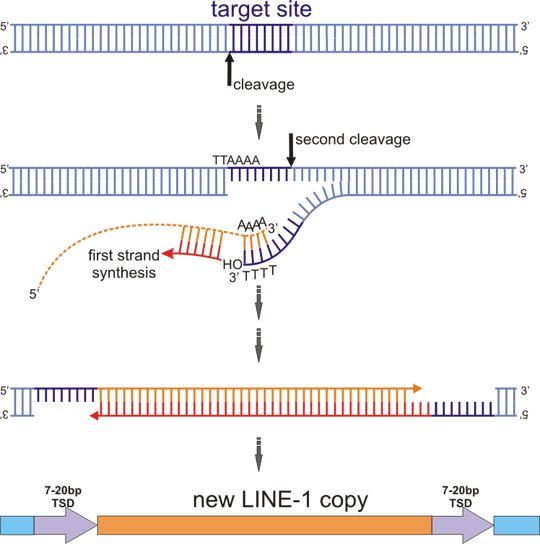
The team screened 406 retrotransposon candidates and engineered one, Vingi-1_Acar, to write RNA templates around 2,200 nucleotides long into DNA. In humanized mice given a single 1 mg/kg dose, CD19 CAR-T cells peaked near 0.5% of T cells while CD20 CAR-T cells reached about 15%, and B cell counts stayed low through the 38-day CD20 study. The model uses mice carrying human blood cells, not people.

Why it matters

If it holds in people, CAR-T could be made by infusing RNA instead of extracting, engineering and reinfusing a patient's cells.

Questions about this story

Free account needed to ask — your question is kept and asked for you right after sign-up. Answers are public.

No questions yet — be the first to ask.

Key Indicators

~28%
CD19 CAR expression after lipid nanoparticle delivery in vitro
Share of T cells expressing the receptor when all-RNA components were delivered by lipid nanoparticle, versus about 16% by nucleofection.
~0.5%
Peak CD19 CAR-T cells in humanized mice
Measured on day 11 after a single 1 mg/kg dose; template-only control mice showed none.
~15%
CD20 CAR-T cells at day 11 in mice
Higher than the CD19 result, from a template of similar length.
406
Retrotransposon candidates screened
Drawn from an initial set of roughly 9,000 retroelements identified computationally.
38 days
Length of the CD20 in vivo study
B cell depletion held to the end, with levels near undetectable in blood and spleen.

Voices

Curated perspectives — historical figures and your fellow readers.

Sign up to generate historical perspectives on this story.

People Involved

Organizations Involved

Timeline

August 2025 October 2026

3 events Latest: October 21st, 2026 · 1 week ago
  1. Gene Writers build CAR-T cells inside humanized mice

    Latest Research

    Cell published a study showing engineered non-LTR retrotransposons inserting CD19 and CD20 CAR templates in vivo via T-cell-targeted lipid nanoparticles, with sustained B cell depletion.

  2. Avian R2 elements catalogued for targeted integration

    Research

    A Nature Biotechnology paper searched 1,139 avian genomes, identified 159 R2 retrotransposons and engineered them for all-RNA-mediated targeted DNA integration in human cells.

  3. Avian R2 retrotransposon engineered to insert DNA in human cells

    Research

    Researchers at the Chinese Academy of Sciences reported an R2 retrotransposon system, R2Tg, active in human cells at low efficiency before optimization.

Scenarios

1

First human trial of retrotransposon-written CAR-T opens

Unlikely Resolves by Q2 2029

Discussed by: The paper's authors, who note that retargeting the elements would require extensive additional engineering before therapeutic use

The mouse results would need replication in larger animals and a manufacturing process for clinical-grade RNA. A Phase 1 registration would mark the point where in vivo gene writing moves from a mouse model into patients.

2

Independent lab reproduces in vivo CAR-T writing in a primate

Possible Resolves by End of 2028

Discussed by: Gene delivery researchers who have followed lipid nanoparticle targeting of T cells

The humanized mouse model limits how far the results generalize. A published primate study from a separate group, showing CAR expression and B cell depletion after RNA delivery, would show the approach travels beyond one team's hands.

3

Truncated insertions force a template redesign before human testing

Possible Resolves by Q2 2028

Discussed by: The authors, who flag truncated integrants as a safety concern unique to the platform

The paper reports that shorter-than-expected insertions accumulate toward one end of the template, and that these fragments could carry promoter sequences that alter nearby gene expression. A redesign, such as switching cargo orientation, would show up as a changed template in later publications.

Historical Context

3 moments from history that rhyme with this story — and how they unfolded.

1997

Sleeping Beauty transposon reconstructed (1997)

Zoltán Ivics and Zsuzsanna Izsvák rebuilt a working transposase from defective fish DNA sequences, producing Sleeping Beauty, and showed it could insert DNA in mammalian cells.

Then

The element became a tool for insertional mutagenesis screens and, later, for engineering CAR-T cells without viruses.

Now

It established that an ancient, reconstructed mobile element could serve as a gene delivery vehicle in human cells.

Why this matters now

Gene Writers follows the same logic with a different class of element, using an RNA intermediate to carry much larger cargo.

2021

First in vivo CRISPR editing in patients (2021)

Intellia reported interim results from a trial infusing lipid nanoparticles carrying CRISPR components into patients with transthyretin amyloidosis, editing cells inside the body rather than in a lab dish.

Then

The results established lipid nanoparticle RNA delivery as a route to editing inside patients, initially targeting the liver.

Now

In vivo delivery became the field's main alternative to extracting and editing cells, but most programs still aimed at disabling genes rather than adding them.

Why this matters now

Gene Writers uses the same delivery idea to insert a gene-length sequence and to reach T cells rather than the liver.

2017

First CAR-T approval (2017)

The Food and Drug Administration approved tisagenlecleucel for pediatric acute lymphoblastic leukemia, the first gene therapy cleared in the United States.

Then

Viral engineering of a patient's own T cells became a standard manufacturing route for CAR-T therapy.

Now

The approach stayed bespoke: cells are collected, engineered and reinfused, with weeks of processing per patient.

Why this matters now

The step the Gene Writers paper targets is exactly that extraction and lab engineering.

Sources

(7)