
Pull to refresh
Logo
Daily Brief
Following
Why
Iran's retaliatory campaign spreads from Gulf military bases to European embassies

Iran's retaliatory campaign spreads from Gulf military bases to European embassies

Force in Play
By Newzino Staff |

An explosion at the US Embassy in Oslo marks the first suspected Iran-linked attack on a Western diplomatic facility in Europe since the war began

Yesterday: Incendiary device detonates at US Embassy in Oslo

Overview

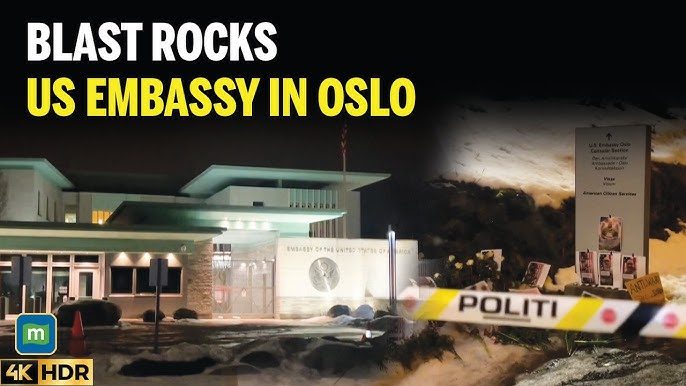
For more than four decades, US embassies in the Middle East and Africa have faced bombings, sieges, and missile strikes. None has been attacked in Western Europe — until an incendiary device detonated at the entrance of the US Embassy in Oslo at 1:00 a.m. on March 8, shattering windows and sending smoke into the street. No one was injured. Norwegian police say terrorism is one hypothesis under investigation, and they are weighing whether the blast is connected to the eight-day-old US-Iran war.

Key Indicators

7+
US service members killed
American military deaths since the war began on February 28, mostly from drone strikes in Kuwait
9+
Countries with US assets targeted
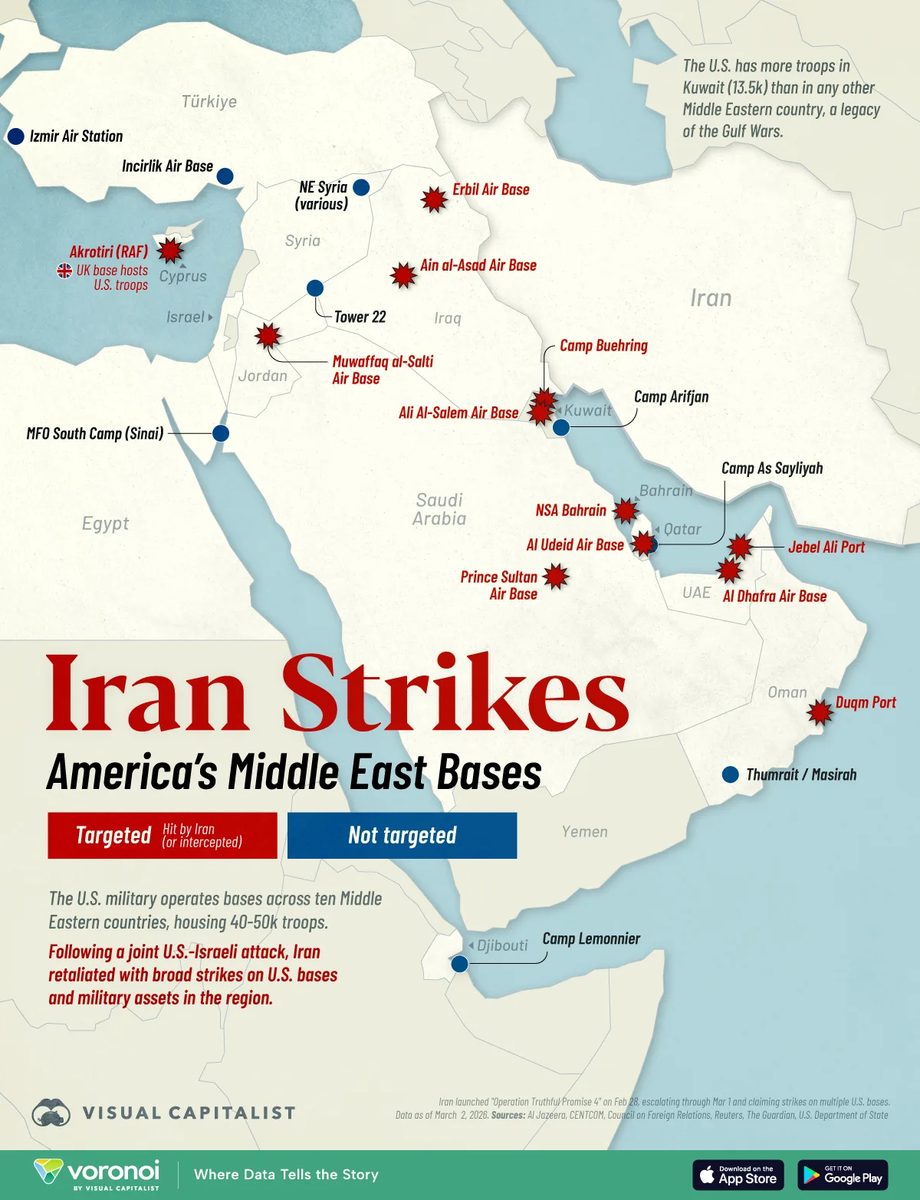
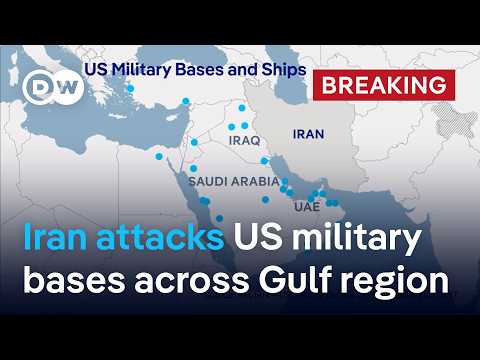
Iran has struck targets in Israel, Kuwait, Saudi Arabia, Bahrain, Qatar, UAE, Iraq, Jordan, and Cyprus — Oslo would extend the list to Europe
~35%
Oil price surge
Brent crude prices rose roughly 35% in the first week of the conflict after Iran restricted traffic through the Strait of Hormuz
14
Countries under US travel advisory
The State Department has advised Americans to evacuate from 14 countries across the Middle East and closed multiple embassies

Interactive

Exploring all sides of a story is often best achieved with Play.

Ever wondered what historical figures would say about today's headlines?

Sign up to generate historical perspectives on this story.

Sign Up

Debate Arena

Two rounds, two personas, one winner. You set the crossfire.

People Involved

Ayatollah Ali Khamenei
Former Supreme Leader of Iran (Killed February 28, 2026)
Mojtaba Khamenei
Mojtaba Khamenei
New Supreme Leader of Iran (Named successor to his father)
Frode Larsen
Frode Larsen
Leader of Oslo police joint investigation and intelligence unit (Leading the embassy blast investigation)
Nasser Makarem Shirazi
Grand Ayatollah, senior Shia cleric in Iran (Issued fatwa calling for holy war against the US and Israel)
Astri Aas-Hansen
Astri Aas-Hansen
Norwegian Justice Minister (Overseeing government response to embassy attack)
Espen Barth Eide
Espen Barth Eide
Norwegian Foreign Minister (In contact with US Embassy officials)

Organizations Involved

Islamic Revolutionary Guard Corps (IRGC)
Military Organization
Status: Directing Iran's retaliatory campaign

Iran's ideological military branch responsible for overseas operations, proxy warfare, and the country's ballistic missile and drone arsenal.

Oslo Police District
Law Enforcement Agency
Status: Leading investigation into embassy explosion

The Norwegian police district responsible for the capital, now investigating the embassy blast with dogs, drones, helicopters, and cooperation from US authorities.

Europol
Europol
International Law Enforcement Agency
Status: Warned of elevated terrorism threat across the EU

The EU's law enforcement agency, which issued warnings of an elevated terrorism threat across Europe in connection with the US-Iran conflict.

Timeline

  1. Incendiary device detonates at US Embassy in Oslo

    Attack

    An explosion struck the entrance of the US Embassy in Oslo, Norway, causing minor structural damage and shattered glass but no injuries. Norwegian police are investigating under multiple hypotheses, including terrorism linked to the Iran conflict. No suspects have been identified.

  2. Iran warns Europeans are 'legitimate targets'

    Statement

    Iran's deputy foreign minister warned that Europeans will become legitimate targets if their governments join the war effort. Europol separately warned of an elevated terrorism threat across the EU.

  3. Strait of Hormuz effectively closed; oil prices surge

    Economic

    The IRGC prohibited vessel passage through the Strait of Hormuz. Tanker traffic dropped by roughly 70% and Brent crude prices surged approximately 35%.

  4. Germany warns of Iranian sleeper cells in Europe

    Intelligence

    German intelligence officials warned that Iranian sleeper cells could be activated in Europe following the fatwa. Experts assessed the risk of spontaneous attacks and cell activation as 'relatively high.'

  5. Hezbollah strikes Israel; Lebanon offensive follows

    Military

    Hezbollah launched missiles and drones at northern Israel. Israel responded with a massive assault across Lebanon, killing at least 217 people and displacing hundreds of thousands.

  6. Fatwa declared; drone strikes RAF base on Cyprus

    Military

    Grand Ayatollah Makarem Shirazi issued a fatwa calling for holy war against the US and Israel. Separately, a Shahed-type drone struck the Royal Air Force base at Akrotiri on Cyprus — the first strike on a Western military facility in Europe.

  7. US and Israel launch Operation Epic Fury; Khamenei killed

    Military

    Joint US-Israeli airstrikes hit military and government targets in Tehran, Isfahan, Qom, Karaj, and Kermanshah. Supreme Leader Ali Khamenei was killed when his compound was destroyed.

  8. Iran retaliates across the Gulf

    Military

    Iran launched retaliatory drone and missile strikes on US and allied targets in Kuwait, Saudi Arabia, Bahrain, Qatar, and the UAE. Six US soldiers were killed at Shuaiba port in Kuwait — the first American combat deaths of the war.

  9. Trump issues 10-day deadline for Iran deal

    Diplomatic

    After indirect talks in Oman failed to produce results, President Trump gave Iran 10 days to reach a nuclear agreement or face military consequences.

  10. Twelve-Day War: Israel and US strike Iran

    Military

    Israel launched surprise airstrikes on Iranian military and nuclear facilities. The US struck underground nuclear sites at Fordow, Natanz, and Isfahan. A ceasefire was reached on June 24.

Scenarios

1

Oslo blast confirmed as Iran-linked, triggering European security mobilization

Discussed by: Europol's elevated threat assessment, German intelligence warnings about sleeper cells, and analysts at the Soufan Center who have tracked Iran's shift toward using European criminal proxies

Investigators identify a suspect with ties to Iranian intelligence or a pro-Iran network. The confirmation prompts a coordinated European security response: heightened protection at US and Israeli diplomatic facilities, new surveillance measures targeting known Iranian operatives, and potential diplomatic consequences for Iran. The precedent of a confirmed Iranian-directed attack on European soil would fundamentally alter European governments' calculations about staying out of the conflict.

2

Investigation finds no state connection; isolated actor motivated by conflict

Discussed by: Norwegian police, who have emphasized they are working with multiple hypotheses and have not committed to a terrorism theory

The perpetrator turns out to be a lone individual — radicalized by the war's imagery or motivated by personal grievances — without operational ties to Tehran or any organized network. The device's relatively low destructive power and the 1:00 a.m. timing, when the embassy was empty, could suggest an amateur operation. This outcome would still underscore the 'stochastic' terrorism risk that European security services have warned about: a conflict thousands of miles away inspiring uncoordinated attacks on Western soil.

3

Oslo is the first of multiple attacks on Western targets in Europe

Discussed by: West Point's Combating Terrorism Center, which has documented 102 Iranian external operations in Europe since 1979, and the International Centre for Counter-Terrorism, which has tracked Iran's increasing use of European criminal networks

The Oslo blast proves to be part of a broader pattern. Additional attacks or foiled plots emerge across European capitals in the following weeks, directed at US, Israeli, or Jewish targets. Iran's documented capacity for parallel operations — and its recent pivot to hiring European criminals rather than deploying its own agents — makes a distributed campaign plausible. A pattern of attacks could force NATO countries to confront whether defending their own diplomatic facilities constitutes joining the war that Iran warned them against.

4

Conflict de-escalates before retaliation campaign reaches deeper into Europe

Discussed by: Diplomatic analysts noting that Iranian President Pezeshkian has signaled willingness to halt strikes on neighboring countries, and Trump's prediction that the war would last four to five weeks

A ceasefire or de-escalation halts the military conflict before Iran's asymmetric campaign matures in Europe. The Oslo blast remains an isolated incident — a warning shot that never became a pattern. European security services successfully disrupt any planned operations, and the political incentive for attacks diminishes as the military situation stabilizes. This outcome depends heavily on the pace of ceasefire negotiations and whether Iran's new leadership under Mojtaba Khamenei seeks an off-ramp.

Historical Context

Beirut Embassy and Marine barracks bombings (1983)

April-October 1983

What Happened

On April 18, 1983, a suicide bomber drove a van carrying 2,000 pounds of explosives into the US Embassy in Beirut, killing 63 people including 17 Americans and 8 CIA officers — the deadliest single day in CIA history. Six months later, a truck bomb equivalent to 18,000 pounds of dynamite destroyed the Marine barracks at Beirut airport, killing 241 US service members. Both attacks were attributed to proto-Hezbollah operatives backed by Iran's Revolutionary Guard Corps.

Outcome

Short Term

The US withdrew its military forces from Lebanon in February 1984. US federal courts later held Iran liable and ordered $239 million in damages to victims and families.

Long Term

The bombings established Iran and Hezbollah's template for asymmetric attacks on US military and diplomatic targets — a template now being deployed on a larger scale. They also prompted the Inman Report, which set new embassy security standards including setback distances and blast-resistant construction.

Why It's Relevant Today

The 1983 attacks demonstrated that Iran would use proxy forces to strike US facilities far from the battlefield when directly confronting American military power was impossible. The current retaliation campaign — drones instead of truck bombs, spread across continents instead of concentrated in Beirut — represents the same strategic logic adapted to modern capabilities.

Foiled Iranian bomb plot against opposition rally near Paris (2018)

June 2018

What Happened

European intelligence services disrupted a plot by Assadolah Assadi, an Iranian diplomat stationed in Vienna, to bomb a large Iranian opposition rally near Paris. Assadi personally delivered 500 grams of TATP explosive and 22,000 euros to a Belgian-Iranian couple recruited to carry out the attack. He was arrested in Germany, where he lacked diplomatic immunity.

Outcome

Short Term

A Belgian court sentenced Assadi to 20 years in prison — the first time a serving Iranian diplomat was convicted of terrorism in Europe. Three co-conspirators received sentences of 15 to 18 years.

Long Term

The plot exposed Iran's use of diplomatic cover for terrorist operations in Europe and prompted a tactical shift. After Assadi's arrest, Iranian intelligence increasingly turned to hiring European criminals — from drug traffickers to gang members — to conduct surveillance and attacks, making operations harder for intelligence services to detect.

Why It's Relevant Today

The Assadi case proved that Iran has the infrastructure, willingness, and operational reach to conduct attacks in Western Europe. The shift to criminal proxies since 2018 means the Oslo perpetrator — if state-linked — may not fit the profile of a known Iranian agent, complicating the investigation.

1998 US Embassy bombings in Kenya and Tanzania

August 1998

What Happened

On August 7, 1998, nearly simultaneous truck bombs detonated outside US Embassies in Nairobi, Kenya, and Dar es Salaam, Tanzania, killing 224 people — including 12 Americans — and wounding more than 4,500. Al-Qaeda orchestrated both attacks. Neither embassy met the security standards set after the 1983 Beirut bombings; the Dar es Salaam building sat just 25 feet from the street.

Outcome

Short Term

President Clinton ordered cruise missile strikes on al-Qaeda targets in Sudan and Afghanistan 13 days later. Over 900 FBI agents deployed overseas for the investigation. Osama bin Laden was indicted in November 1998.

Long Term

A post-attack review found that 85% of US embassies worldwide still did not meet security standards. The bombings led to a massive embassy construction and fortification program that continues to shape American diplomatic architecture worldwide.

Why It's Relevant Today

The East Africa bombings showed that diplomatic facilities outside major conflict zones remain vulnerable. The Oslo embassy, located in a country with no direct involvement in the US-Iran war, faces a similar dynamic: it is a symbolic American target in a location where security posture may not match the current threat environment.

Sources

(18)