Anchor

Mercury's surface holds far less silicon dioxide than thought
New CapabilitiesNew infrared calibration finds silica down a quarter from old estimates; BepiColombo arrives in November to verify
Today: Low-silica finding gains wide attentionNew here? Follow stories to track developments over time. Create a free account to get updates when stories you care about change.
Overview
Updated 1 hour agoMercury's surface holds about 37 percent silicon dioxide by mass, up to 25 percent less than earlier estimates. That gap points to a hotter volcanic past, with lava rising from deeper mantle regions melted at extreme temperatures.
No lander has touched Mercury and no sample has ever been returned, so every claim about its surface comes from remote sensing. BepiColombo, a joint European Space Agency and Japan Aerospace Exploration Agency mission, enters Mercury orbit in November and carries an infrared instrument built to measure this exact quantity.
Why it matters
If confirmed, Mercury's deep, hot melting rewrites models of how the innermost planet's crust formed and how differently it evolved from Earth.
Questions about this story
Free account needed to ask — your question is kept and asked for you right after sign-up. Answers are public.
No questions yet — be the first to ask.
Key Indicators
37%
Silicon dioxide on Mercury's surface (by mass)
New lab-calibrated infrared estimate, down from the 49–60% range based on MESSENGER data.
25%
Maximum reduction from previous estimates
The gap between 37% and the low end of the old 49–60% range.
8.5 µm
Christiansen Feature wavelength used for estimate
Infrared spectral feature that directly constrains silicon dioxide content.
Nov 2026
BepiColombo Mercury orbital insertion
Scheduled for November 21, 2026, with full science operations from April 2027.
4.1–3.5 bya
Mercury's volcanic era
Lava plains and explosive vents formed during this window, per MESSENGER findings.
Related Media
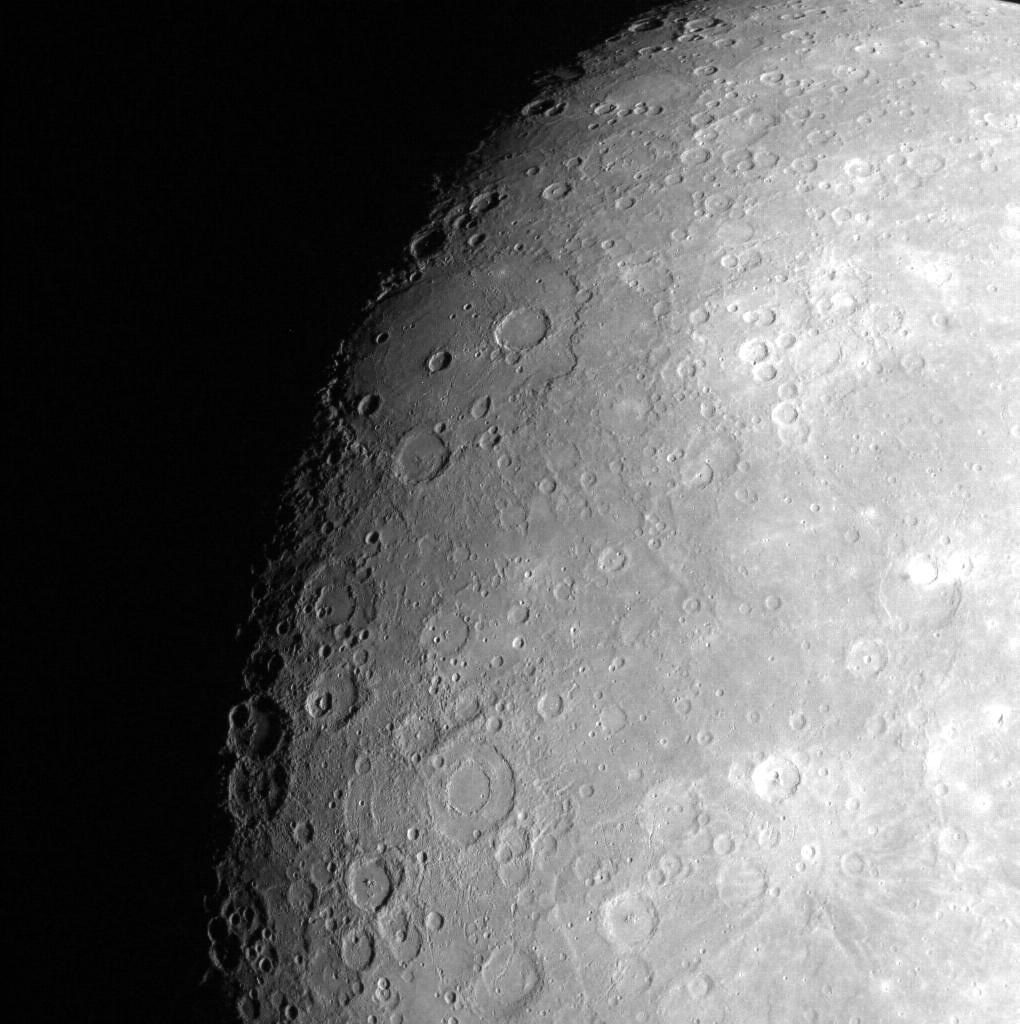
Mercury's Surface (NASA, MESSENGER, 04/13/11)
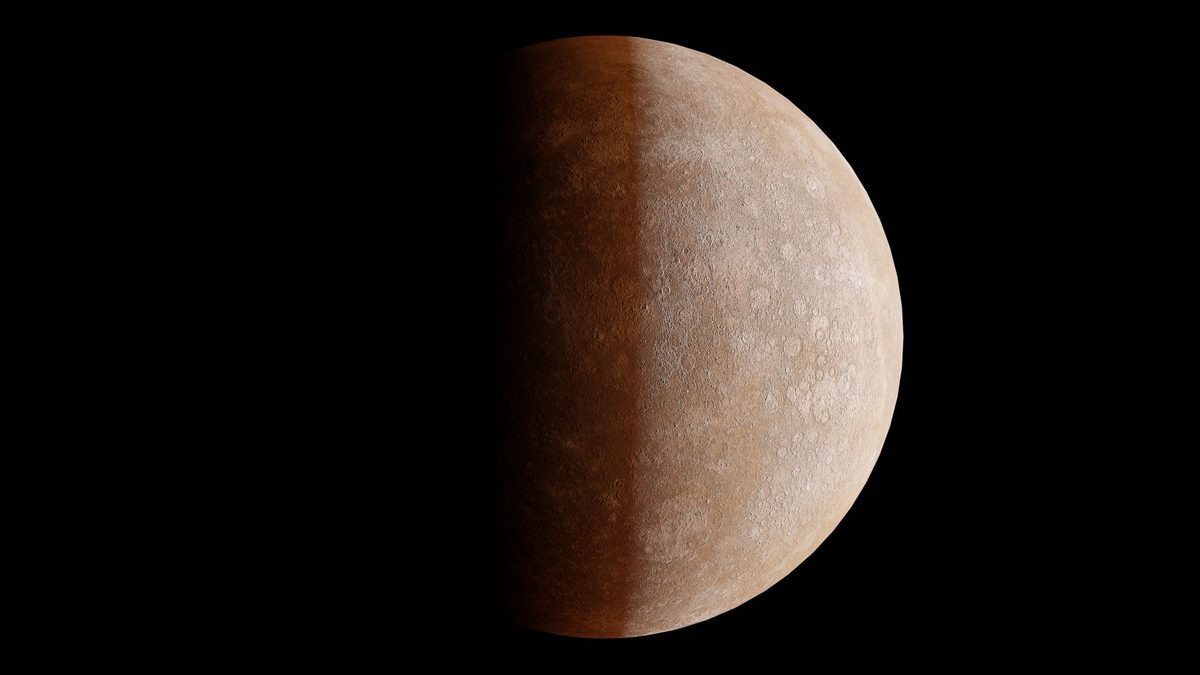
Detailed photo of Mercury's surface with visible craters against black space.
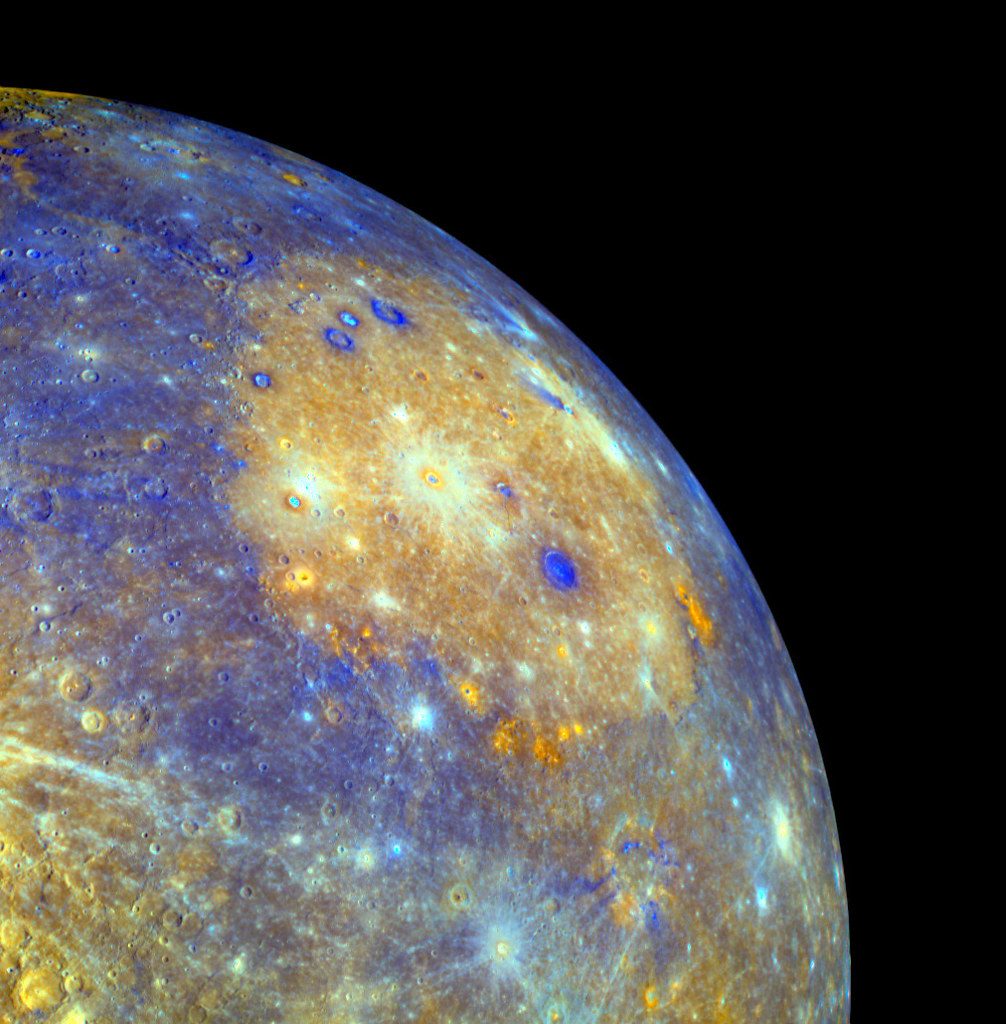
Mercury's Caloris Basin
1.8K views
2:22:15
BepiColombo Begins Historic Mercury Arrival | ESA/JAXA Mission
Space Googlevesaire

5.6K views
23:22
NASA JUST REVEALED:The Vera Rubin Observatory ...
Proof
Images from Openverse under Creative Commons licenses. Videos from YouTube.
Voices
Curated perspectives — historical figures and your fellow readers.
Play
Exploring all sides of a story is often best achieved with Play.
Most of these play right now — no account needed. Sign up to save scores, keep a streak, and unlock Debate and Predict.
Log in
Sign Up
Higher or Lower
A number from this story, against one from elsewhere in the news — guess which is bigger, then keep the chain going. 5 rounds, 3 strikes; a miss costs a strike and resets your streak.
Example
Anchor
EU tariff revenue
$52B
Big for this kind of number
Mystery
Pentagon AI contract
?
Round 1
Streak: 0
Mystery
?
Keyboard: ↓/L lower · ↑/H higher
0 pts
Best streak: 0 · Rounds: 0
0 points — sign up to put that on the leaderboard.
Now try on this story
Connections
Sixteen names from the news. Find the four hidden groups of four. Four mistakes max.
Loading today's puzzle…
0/4 groups
Mistakes
Sign up to keep a daily streak — a new puzzle lands every day.
Now try on this story
Exit debate?
Your progress in this debate will be lost.
How it works
- 1 Two AI personas square off on this story.
- 2 You predict who'll win each round — correct picks earn XP.
- 3 One crossfire question is yours to fire. Pick it carefully.
Couldn't generate a topic
Select Your Champions
Choose one persona for each side of the debate
DEBATE TOPIC
Choose personas with different perspectives for a more dynamic debate.
SIDE A (PRO)
Select debater for this side:
No debate personas available right now.
SIDE B (CON)
Select debater for this side:
No debate personas available right now.
VS
Get ready to make your prediction...
Round of
Claim
Evidence
Stakes
Crossfire Answer
Closing Statement
Claim
Evidence
Stakes
Crossfire Answer
Closing Statement
Your Crossfire Question
Generating arguments...
Who's Got This Round?
Make your prediction before the referee scores
The referee scores both sides on
Correct predictions earn +20 XP
· Press 1 or 2 to pick
Evidence
40%
Logic
30%
Detail
20%
Style
10%
Round Results
Your Pick
Not this time
(%)
Overall Score
/10
Your Pick
Not this time
(%)
Overall Score
/10
Set the Crossfire
Pick the question both personas must answer in the final round
Crafting crossfire questions...
Choosing a question earns +10 XP crossfire bonus
🏆
Total XP Earned
Cred Change
Predictions
Debate Oracle! You called every round!
Sharp Instincts! You know your debaters!
The Coin Flip Strategist! Perfectly balanced!
The Contrarian! Bold predictions!
Inverse Genius! Try betting the opposite next time!
XP Breakdown
Base completion
+20 XP
Rounds played ( rounds x 5 XP)
+ XP
Correct predictions ( correct x 20 XP)
+ XP
Crossfire bonus
+10 XP
Accuracy
%
Prediction History
Round
You picked:
✓
✗
Now try on this story
Keep debating to level up your credibility and unlock achievements
People Involved
Organizations Involved
Max Planck Institute for Solar System Research
Research Institute
Led the new silica study; home of the Experimental Laboratory Magma Ocean group
German planetary science institute that led the new Mercury surface composition study with the Universities of Münster and Göttingen.
BepiColombo (ESA/JAXA joint mission)
Space Mission
Approaching Mercury; orbit insertion scheduled November 21, 2026
Two-probe ESA/JAXA mission on an eight-year cruise; its MERTIS infrared instrument will test the new low-silica estimate.
NASA MESSENGER mission
Space Mission
Completed 2015; its data underpin the older silica estimates now being questioned
First spacecraft to orbit Mercury (2011–2015); its elemental ratio data produced the 49–60% silica estimates now being revised.
MERTIS instrument team (DLR / University of Münster)
Instrument Development Team
Will collect the confirming measurements from April 2027
Built the Mercury Radiometer and Thermal Infrared Spectrometer that will test the new silica estimate at high resolution.
Timeline
March 2011 April 2027
8 events
Latest: Today
Tap a bar to jump to that date
-
MERTIS full science operations begin
Upcoming Mission MilestoneMERTIS infrared instrument maps Mercury's mineralogy, covering the Christiansen Feature used in the new calibration.
-
BepiColombo scheduled to enter Mercury orbit
Upcoming Mission MilestoneOrbital insertion date; full science operations follow in April 2027.
-
Low-silica finding gains wide attention
Today DiscoveryNews of the hot volcanic past spreads as the study reaches broad audiences.
-
BepiColombo probes separate from transfer module
Mission MilestoneBoth science probes detach from the transport module, starting the final approach phase.
-
New silica study published
DiscoveryPlanetary Research journal reports 37% silicon dioxide on Mercury's surface, up to 25% below older estimates.
-
BepiColombo launches
Mission MilestoneJoint ESA/JAXA mission lifts off from Kourou, French Guiana, on an eight-year cruise.
-
MESSENGER mission ends
Mission MilestoneSpacecraft impacts Mercury's surface after four years of orbital observations.
-
MESSENGER enters Mercury orbit
Mission MilestoneFirst spacecraft to orbit Mercury; begins mapping surface composition from elemental ratios.
Scenarios
1
BepiColombo Confirms Mercury's Low-Silica Crust
Likely
Resolves by End of 2027
Discussed by: Christian Renggli and the Max Planck research team; the study authors expect MERTIS to verify the low value
MERTIS begins full operations in April 2027 and maps the Christiansen Feature across Mercury's surface. If its measurements show silica near 37 percent by mass, the deep-melting model solidifies. The crust would record mantle material melted at greater depths and higher temperatures than Earth's volcanic rocks.
2
MERTIS Revises Silica Estimate Back Upward
Possible
Resolves by End of 2027
Discussed by: Planetary scientists noting the new infrared calibration method is untested at Mercury's high surface temperatures
If MERTIS data show silica well above 37%, closer to the MESSENGER-era 49–60% range, the infrared calibration method may need adjustment for Mercury's surface conditions. The lab experiments used to calibrate the method might not fully replicate the planet's thermal environment, pushing the estimate off.
3
Oxygen-Loss Theory Gains Ground on Mercury's Low Silica
Possible
Resolves by Q2 2028
Discussed by: The study authors, who note Mercury could have gradually lost oxygen over billions of years
Rather than deep mantle melting alone, the low silica could reflect oxygen escaping from Mercury's surface over time. Follow-up studies tracking surface chemistry, atmospheric escape, or isotopic ratios could separate the two mechanisms. If the oxygen-loss path gains support, the story shifts from 'hotter interior' to 'leaky planet.'
Historical Context
3 moments from history that rhyme with this story — and how they unfolded.
July 1969 – December 1972
Apollo lunar samples recalibrate remote sensing (1969–1972)
Before Apollo returned Moon rocks, telescopic and early orbital remote sensing gave rough estimates of lunar surface composition. Apollo samples provided direct measurements that differed substantially from predictions in key elements, forcing recalibration of every remote-sensing technique used to study the Moon.
Then
Lunar remote sensing got anchored to real samples; calibration curves were redrawn.
Now
Established the principle that remote sensing needs independent calibration. For bodies without samples, calibration must come from laboratory experiments and cross-checking instruments.
Why this matters now
Mercury has never had a rock sample returned. The new infrared calibration, tested in the lab, is the closest scientists can get to a ground-truth anchor for an unreachable surface.
August 1990 – October 1994
Magellan's radar mapping overturns Venus assumptions (1990–1994)
NASA's Magellan spacecraft mapped 98 percent of Venus with synthetic aperture radar, revealing a volcanic surface completely unlike the picture built from Earth-based radar and earlier flybys. It showed young resurfacing, vast volcanic plains, and shield volcanoes.
Then
Overturned prior understanding of Venus's geology, showing a planet resurfaced by volcanism.
Now
Demonstrated that orbital instruments can drastically revise surface understanding built from less direct methods.
Why this matters now
Like Magellan at Venus, BepiColombo's direct instruments may substantially revise the MESSENGER-era estimates for Mercury — in either direction.
March 2011 – April 2015
MESSENGER reshapes Mercury's story (2011–2015)
MESSENGER was the first spacecraft to orbit Mercury, after Mariner 10's 1970s flybys. Its instruments measured elemental abundances that scientists used to estimate surface silica at 49–60 percent. It also revealed lava plains over a kilometer thick, pyroclastic vents, and explosive volcanic features called hollows.
Then
Produced the most detailed view of Mercury's surface chemistry ever, replacing decades of flyby-era guesses.
Now
Its elemental-ratio estimates became the standard reference for Mercury's composition. Those estimates are now being challenged by the new infrared work.
Why this matters now
The old silica numbers came from MESSENGER's elemental-ratio method. BepiColombo's MERTIS uses a different, direct infrared approach, providing an independent check of a decade-old estimate.
Sources
(10)Related Stories
Six icy moons hide liquid oceans beneath their shells
New Capabilities
Updated 5 days ago
Interstellar comet 3I/ATLAS is bursting with methanol
New Capabilities
Updated 3 days ago
Curiosity rover finds new class of organic molecules on Mars
New Capabilities
Updated May 31
IBM and NASA release open-source AI model for lunar exploration
New Capabilities
Updated Yesterday
NASA's Psyche mission to a metal asteroid
New Capabilities
Updated May 15
The K2-18b biosignature hunt
New Capabilities
Updated May 19