Pull to refresh
Logo
Daily Brief
Following
Why
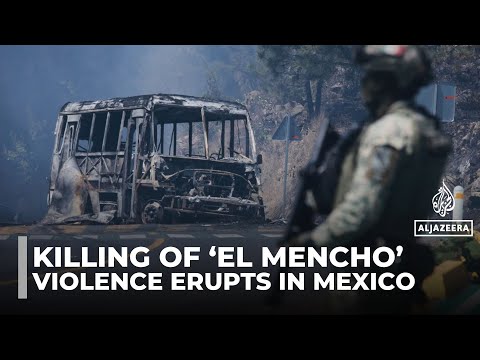
Mexican military kills CJNG leader El Mencho, triggering nationwide cartel retaliation

Mexican military kills CJNG leader El Mencho, triggering nationwide cartel retaliation

Force in Play
By Newzino Staff |

The death of Mexico's most-wanted drug lord removes a kingpin but opens a dangerous power vacuum in the world's largest fentanyl trafficking organization

6 days ago: Mexican Army kills El Mencho near Tapalpa

Overview

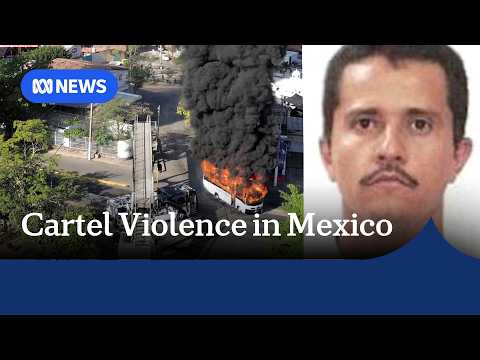
For more than a decade, Nemesio Oseguera Cervantes — known as El Mencho — built the Jalisco New Generation Cartel into one of the most powerful drug trafficking organizations on earth, with an estimated $50 billion in assets and operations spanning five continents. On February 22, 2026, the Mexican Army killed him during a coordinated raid near Tapalpa, Jalisco, ending a manhunt that carried a $15 million United States bounty.

Key Indicators

$50B
Estimated CJNG assets
Mexican government estimate of the Jalisco New Generation Cartel's total asset holdings under El Mencho's leadership
$15M
US bounty on El Mencho
Reward offered by the US State Department's Narcotics Rewards Program for information leading to his arrest or conviction
9
Security forces killed
Mexican National Guard members, a jail guard, and a state prosecutor's agent killed during the operation and retaliatory attacks
12+
States hit by retaliation
Mexican states where CJNG operatives launched violent retaliatory attacks including road blockades, arson, and armed clashes

Interactive

Exploring all sides of a story is often best achieved with Play.

Dorothy Parker

Dorothy Parker

(1893-1967) · Jazz Age · wit

Fictional AI pastiche — not real quote.

"They've cut off the serpent's head, and now marvel that the body writhes. One would think, after sufficient centuries of this particular lesson, humanity might eventually trouble itself to learn it."

Ever wondered what historical figures would say about today's headlines?

Sign up to generate historical perspectives on this story.

Sign Up

Debate Arena

Two rounds, two personas, one winner. You set the crossfire.

People Involved

Nemesio Rubén Oseguera Cervantes
Founder and leader of the Jalisco New Generation Cartel (CJNG) (Killed on February 22, 2026)
Claudia Sheinbaum
Claudia Sheinbaum
President of Mexico (In office; praised security forces and called for calm)
Pablo Lemus Navarro
Pablo Lemus Navarro
Governor of Jalisco (Declared red alert and suspended public services across the state)
Rubén Oseguera González
Former CJNG second-in-command; son of El Mencho (Convicted in U.S. federal court; imprisoned)

Organizations Involved

JA
Jalisco New Generation Cartel (CJNG)
Transnational Criminal Organization / Designated Foreign Terrorist Organization
Status: Leadership decapitated; retaliatory violence ongoing; succession uncertain

Mexico's most aggressive drug trafficking organization, designated a foreign terrorist organization by the United States in February 2025, with operations spanning the Americas, Europe, Asia, and Africa.

ME
Mexican Army (Secretaría de la Defensa Nacional)
Military
Status: Led the operation that killed El Mencho; coordinating post-operation security

Mexico's ground military force, which has served as the primary institution fighting drug cartels since the Mexican government escalated its drug war strategy in 2006.

United States Drug Enforcement Administration (DEA)
Federal Law Enforcement Agency
Status: Provided intelligence support for the operation

The primary U.S. agency responsible for combating drug trafficking, which has long pursued El Mencho and CJNG as top-priority targets.

Timeline

  1. Mexican Army kills El Mencho near Tapalpa

    Military Operation

    Mexican Army special forces, supported by the National Guard, Air Force, and U.S. intelligence, cornered El Mencho and his security detail near Tapalpa, Jalisco. Oseguera Cervantes was critically wounded in the firefight and died while being airlifted to Mexico City. Six other cartel members were killed and two arrested.

  2. CJNG launches retaliatory attacks across 12+ states

    Retaliation

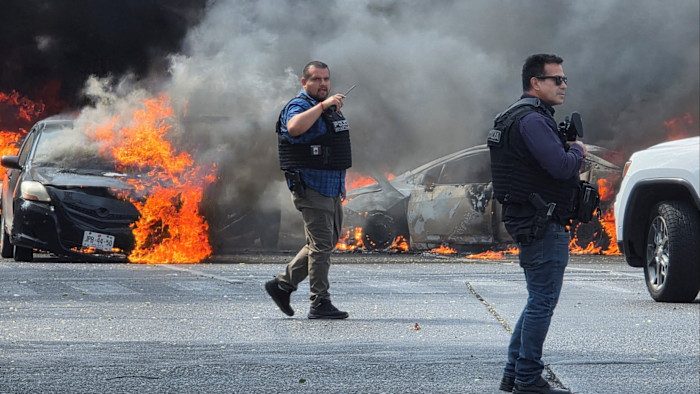
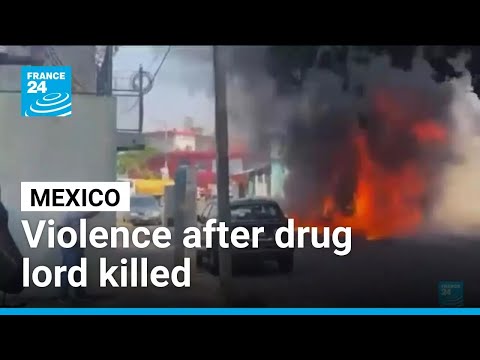
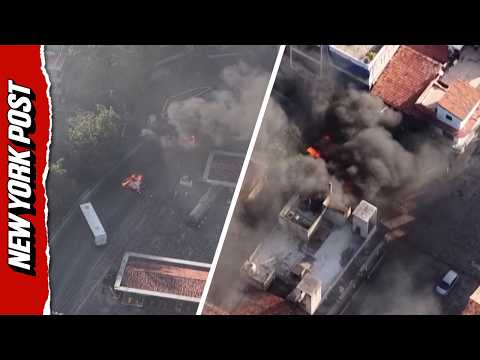
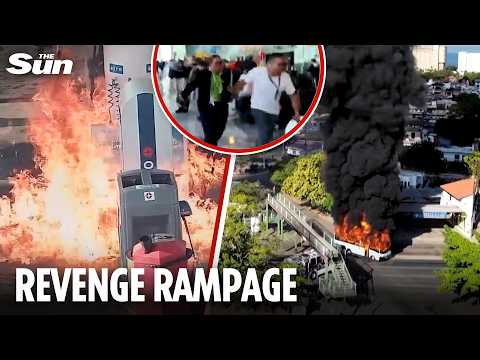
    Within hours, CJNG operatives torched vehicles, blockaded highways, and clashed with security forces across Jalisco, Colima, Michoacán, Nayarit, Guanajuato, Tamaulipas, and other states. More than 70 attacks were reported in Guanajuato alone. Prisoners rioted at a Puerto Vallarta lockup, killing a jail guard.

  3. Governor declares red alert; airlines cancel Puerto Vallarta flights

    Government Response

    Jalisco Governor Pablo Lemus Navarro declared a statewide red alert, suspending public transportation, canceling schools, and banning large gatherings. Delta, American, Alaska, and Air Canada canceled flights to Puerto Vallarta. The U.S. Embassy issued shelter-in-place advisories for Americans in three states.

  4. US designates CJNG a foreign terrorist organization

    Designation

    The Trump administration designated the Jalisco New Generation Cartel as a foreign terrorist organization and a Specially Designated Global Terrorist entity, citing fentanyl trafficking, extortion, and weapons trade.

  5. El Mencho's wife arrested as CJNG financial chief

    Arrest

    Rosalinda González Valencia, known as La Jefa, was arrested in Zapopan, Jalisco and identified as the cartel's financial chief.

  6. El Menchito extradited to the United States

    Legal

    El Mencho's son was extradited to face federal charges in Washington, D.C., further isolating the cartel leader from family members who might have succeeded him.

  7. CJNG shoots down military helicopter

    Attack

    The cartel shot down a Mexican Army helicopter with a rocket-propelled grenade during a security operation in Jalisco, demonstrating military-grade capabilities that few criminal organizations possess.

  8. CJNG ambushes and kills 15 police officers

    Attack

    Cartel gunmen ambushed a state police convoy in Jalisco, killing 15 officers in one of the deadliest single attacks against Mexican security forces in the modern drug war.

  9. El Mencho's son arrested

    Arrest

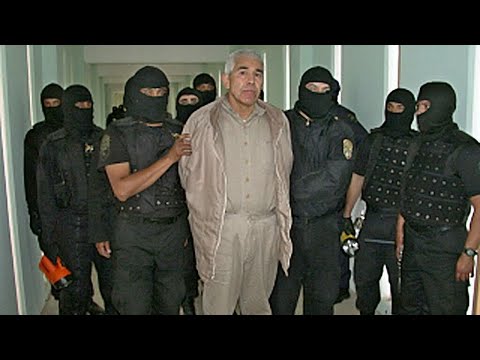
    Mexican authorities captured Rubén Oseguera González, known as El Menchito and considered the cartel's second-in-command, stripping El Mencho of his closest operational heir.

  10. CJNG announces itself with Veracruz massacre

    Escalation

    The cartel dumped 35 bodies of rival Los Zetas members on a Veracruz highway during rush hour, declaring it would "cleanse" the state — a public signal of the organization's ambition and brutality.

  11. Sinaloa capo's death seeds CJNG's creation

    Origin

    Mexican security forces killed Sinaloa Cartel capo Ignacio Coronel in Guadalajara, fracturing the Milenio Cartel. Oseguera Cervantes and Érick Valencia Salazar filled the vacuum by founding the Jalisco New Generation Cartel.

Scenarios

1

CJNG fragments into warring regional factions

Discussed by: InSight Crime, Brookings Institution, and security analysts studying cartel 'decapitation' strategies

With El Mencho's son, brother, and wife all previously imprisoned, no obvious successor exists. Regional commanders who managed semi-autonomous operations across Mexico begin fighting each other for control of lucrative trafficking corridors, particularly fentanyl routes into the United States. The fragmentation pattern mirrors what happened to the Beltrán-Leyva Organization after its leader was killed in 2009 — the group splintered into at least four competing factions within two years. Violence escalates significantly across CJNG-controlled territory before stabilizing at a new, bloodier equilibrium.

2

A single successor consolidates CJNG under unified command

Discussed by: Latin Times, security analysts, and former DEA officials

One of CJNG's senior regional commanders — potentially someone who controlled operations in a critical trafficking corridor — moves quickly to assert authority and prevent fragmentation. This would require both the loyalty of enough armed cells and the logistical capacity to maintain supply chains. The Sinaloa Cartel managed a version of this after El Chapo's 2016 capture, with Ismael "El Mayo" Zambada and El Chapo's sons sharing power. However, CJNG's more decentralized, cell-based structure makes a clean succession less likely than it was for the more hierarchically organized Sinaloa operation.

3

Sinaloa Cartel and rivals seize CJNG territory, reshaping Mexico's cartel map

Discussed by: DEA annual threat assessments, Americas Quarterly, and Mexican security analysts

The Sinaloa Cartel and smaller regional groups exploit CJNG's leadership vacuum to reclaim territory lost over the past decade, particularly in Jalisco, Michoacán, Guanajuato, and the Pacific coast trafficking corridor. This would likely trigger a period of intensified inter-cartel violence as boundaries are redrawn, potentially resembling the nationwide bloodshed that followed the Beltrán-Leyva split from Sinaloa in 2008. The ultimate result would be a reconfigured but not diminished drug trafficking landscape.

4

US uses killing to justify expanded military or intelligence presence in Mexico

Discussed by: Brookings Institution, NPR, and Mexican political commentators

The Trump administration, which has repeatedly proposed sending U.S. troops to Mexico and designated CJNG a foreign terrorist organization, uses the post-operation chaos as evidence that Mexico cannot manage the security situation alone. Washington pushes for greater operational involvement — whether through expanded intelligence sharing, military advisors, or more covert measures — testing the boundaries that President Sheinbaum has drawn around Mexican sovereignty. The retaliatory violence and threats to American tourists provide political cover for escalation.

Historical Context

Killing of Pablo Escobar and collapse of the Medellín Cartel (1993)

December 1993

What Happened

Colombian security forces, aided by U.S. intelligence and the vigilante group Los Pepes, tracked and killed Medellín Cartel leader Pablo Escobar on a rooftop in his hometown on December 2, 1993. Escobar had been the world's most-wanted drug lord, controlling an estimated 80% of the global cocaine trade.

Outcome

Short Term

The Medellín Cartel collapsed almost immediately. The rival Cali Cartel filled the vacuum and dominated Colombia's cocaine market for two years until its own leaders were captured.

Long Term

Colombia's drug trade didn't shrink — it decentralized. The hierarchical cartel model gave way to dozens of smaller, harder-to-track trafficking organizations. Total cocaine production eventually increased.

Why It's Relevant Today

The most studied case of kingpin removal in drug war history. Escobar's death eliminated one organization but did not reduce drug supply — it atomized the industry into smaller, more resilient pieces. Mexican officials and analysts cite this precedent when debating whether El Mencho's death will reduce or merely restructure trafficking.

Killing of Arturo Beltrán Leyva and the cartel's fragmentation (2009)

December 2009

What Happened

Mexican Marines killed Arturo Beltrán Leyva, head of the Beltrán-Leyva Organization, in a four-hour shootout at his safehouse in Cuernavaca. The operation was considered a major success for President Felipe Calderón's drug war strategy.

Outcome

Short Term

The cartel immediately split as top enforcer Edgar Valdez Villarreal challenged Arturo's brother Héctor for control. The internal war produced a wave of violence across multiple states.

Long Term

Within two years, the organization had fractured into at least four competing factions — the South Pacific Cartel, La Mano Con Ojos, the Independent Cartel of Acapulco, and La Barredora. By 2011, Mexican authorities declared the original organization extinct.

Why It's Relevant Today

The closest Mexican parallel to El Mencho's killing. It demonstrates that removing a cartel's top leader when no clear succession plan exists can produce rapid, violent fragmentation rather than organizational collapse — the drug trade continues through new, often more violent, structures.

Capture of Joaquín "El Chapo" Guzmán and the Sinaloa Cartel's adaptation (2016)

January 2016 – February 2019

What Happened

Mexican forces recaptured Sinaloa Cartel leader Joaquín "El Chapo" Guzmán in January 2016 after his second prison escape. He was extradited to the United States in January 2017 and convicted on all charges in February 2019, receiving a life sentence.

Outcome

Short Term

An internal succession dispute erupted but was resolved after a rival faction leader was arrested. El Chapo's sons and longtime partner Ismael "El Mayo" Zambada established a power-sharing arrangement.

Long Term

The Sinaloa Cartel continued operating at near-full capacity. Multi-ton drug shipments continued uninterrupted. The cartel remained the DEA's top-priority target alongside CJNG.

Why It's Relevant Today

Shows that kingpin removal doesn't always produce fragmentation — if a succession mechanism exists, the organization can adapt. The critical difference with CJNG is that El Mencho's potential successors (son, brother, wife) are all imprisoned, leaving no family-based succession path.

Sources

(12)