Mortgage rates fell for four straight weeks to 7.11% on Nov. 12. The relief may be over: October consumer prices rose 0.4%, and Mortgage News Daily's 30-year rate jumped 12 basis points to 7.30% on Nov. 10.
Traders now put the odds of a quarter-point Fed hike in December at about 93%, according to CME FedWatch. Existing-home sales have fallen to a 16-year low as high rates and prices keep buyers out, even as mortgage applications rose 6.2% in the week after rates dipped.
Why it matters
Every quarter-point move changes monthly payments by hundreds of dollars for buyers already stretched by high home prices.
Questions about this story
Free account needed to ask — your question is kept and asked for you right after sign-up. Answers are public.
No questions yet — be the first to ask.
Key Indicators
7.11%
Freddie Mac 30-year fixed rate (Nov. 12)
Down from 7.18% for a fourth straight weekly decline, the lowest since Sept. 24. A year earlier it averaged 6.24%.
7.30%
Mortgage News Daily 30-year rate (Nov. 10)
Jumped 12 basis points after October CPI came in hot, the largest one-day increase in more than a month.
0.4%
October CPI, monthly increase
Consumer prices rose 0.4% in October, above forecasts. Core CPI rose 0.3%, matching the level Fed Governor Christopher Waller had cited.
93%
Odds of a December quarter-point Fed hike
CME FedWatch puts the chance of a quarter-point increase at the December meeting above 93%. A half-point move is priced at about 15%.
6.2%
Mortgage applications, weekly change
Applications rose 6.2% in the week after rates fell, with refinances up 5% and purchases up 8%. Volume remains below year-ago levels.
16-year low
Existing-home sales
Sales of previously owned homes fell to the lowest level in 16 years as high rates and prices weighed on buyers.
20 events
Latest: 3 days ago
Showing 8 of 20
JK to step
Tap a bar to jump to that date
Jump to
November 2026
Freddie Mac 30-year falls to 7.11%
LatestMarket
The average 30-year fixed rate fell from 7.18% to 7.11%, the fourth straight weekly decline and the lowest since Sept. 24. A year earlier it was 6.24%.
Existing-home sales hit 16-year low
Market
Sales of previously owned homes fell to the lowest level in 16 years as high mortgage rates and home prices weighed on buyers.
Mortgage applications rise 6.2% as rates dip
Market
MBA data show total applications rose 6.2% from the prior week. Refinances rose 5% and purchase applications rose 8%, though both remained below year-ago levels.
October CPI runs hot; 30-year rate jumps to 7.30%
Economic Data
Consumer prices rose 0.4% in October, above forecasts. Mortgage News Daily's average 30-year rate rose 12 basis points to 7.30%, the largest one-day jump in more than a month.
Fed officials signal December hike
Policy
After the hot October CPI, Chicago Fed President Austan Goolsbee called the report 'borderline disturbing.' Governor Christopher Waller said a half-point hike should be considered, and Dallas Fed President Lorie Logan backed two quarter-point increases.
October 2026
Fed holds rates steady in 10-2 vote
Policy
The Fed kept its benchmark at 3.75% to 4%. Cook and Hammack voted for a quarter-point hike. The statement said inflation 'remains elevated.'
Rate trackers ease after the post-CPI spike
Market
MND's survey coupon held at 7.37% Friday, with daily trackers drifting lower into the weekend; one Sunday marketplace tracker showed 7.14%. The ease came despite the hot inflation read.
Freddie Mac holds the 30-year at 7.40%
Market
The rate was unchanged from a week earlier, ending a seven-week climb. It is the highest since Nov. 16, 2023, when it averaged 7.44%. The 15-year edged down to 6.71% from 6.73%.
September CPI comes in hot
Economic Data
Consumer prices rose 0.6% from August, with annual CPI at 3.7%, both above forecasts. The 30-year briefly jumped to 7.56% and market odds of an Oct. 27-28 Fed hike roughly doubled, to about 42%, per CME FedWatch.
Fannie Mae raises 30-year rate forecast
Forecast
Fannie Mae economists now expect the 30-year to average 7.4% this quarter and 7.5% through 2027, up from a prior forecast of 6.8% and 6.7%. They cited stubborn inflation and persistent bond-market pressure.
Applications fall for a seventh straight week
Market
MBA reports total volume down 2.7% for the week ending Oct. 9 and 37.5% below a year earlier. Refinances ran 56% lower year over year; adjustable-rate loans hit 10.5% of applications, their highest share in a year.
Soft jobs report eases rates, firms up case for Fed hold
Market
September payroll growth came in at 29,000 with unemployment at 4.2%. The 10-year Treasury dipped to about 5.18% before closing near 5.28%. Top-tier 30-year rates eased to 7.49%, and markets cut odds of an October Fed hike to roughly 25%.
Freddie Mac records 7.28%, biggest weekly jump in four years
Market
The 30-year rate averaged 7.28%, up from 7.03% a week earlier, the largest one-week increase in about four years and its highest since November 2023, as the 10-year Treasury topped 5.3% intraday.
September 2026
Mortgage applications tumble 6%
Market
MBA reports applications fell 6% from the prior week, the fourth straight weekly drop, as adjustable-rate loans passed 10% of applications.
Top-tier 30-year rate tops 7.5%
Market
Mortgage News Daily records its average top-tier 30-year rate at 7.58%. The 10-year Treasury closed at 5.24% the prior session, its highest level since 2007.
Zillow puts purchase rate at 7.481%
Market
30-year purchase rate edges up from Friday's 7.477%, with the war and oil prices adding pressure.
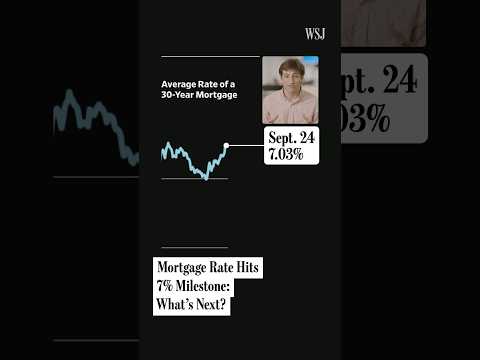
Freddie Mac records 30-year rate at 7.03%
Market
First weekly reading above 7% since January 2025, up from 6.95% the prior week.
Barr signals more hikes likely
Statement
Fed Governor Michael Barr says more rate hikes are likely needed to bring inflation down in a timely fashion.
Fed raises benchmark rate a quarter point
Policy
The target range moves to 3.75%-4.00% at the Sept. 15-16 FOMC meeting.
February 2026
US war in Iran begins
Conflict
The conflict pushes oil prices higher, adding inflation pressure that lifts mortgage rates from near 6%.
Scenarios
1
30-Year Rate Stays Above 7% Into 2027
Likely
Resolves by End of 2026
Discussed by: National Association of Realtors chief economist Lawrence Yun, who calls 7% the 'new normal'; Inman's market coverage
Inflation stays sticky, the Fed holds or hikes again in October, and bond yields remain elevated. Buyers adjust to a higher cost of borrowing and affordability pressure persists into 2027. This is the scenario Yun is publicly preparing buyers for.
2
Fed Hikes Again in October and Rates Push Toward 8%
Deadline passed (Oct 28, 2026)
Discussed by: Reuters, which notes financial markets are pricing in another hike at the late-October meeting
Fresh inflation data or another Barr-style push convinces the Fed to raise rates again on Oct. 27-28. Higher short-term rates drag Treasury yields up further and mortgage rates toward 8%, deepening the affordability squeeze into year-end.
3
Iran De-escalation Pulls Rates Back Below 7%
Unlikely
Resolves by End of 2026
Discussed by: US News, which notes rates tend to fall when the conflict appears closer to resolution
A ceasefire or de-escalation in Iran drops oil prices and cools inflation expectations. Bond yields fall and mortgage rates follow, reversing much of the September surge. US News notes this pattern has played out repeatedly since the war began in late February, with rates and yields easing whenever the conflict seemed near resolution.
The Fed held rates at its Oct. 28 meeting. After October CPI rose 0.4%, markets now price a quarter-point hike in December at about 93%, according to CME FedWatch. That keeps the 30-year rate near 7% into year-end, with an 8% push deferred to 2027 if inflation stays elevated.
5
October CPI Report Sets Near-Term Direction
Deadline passed (Oct 14, 2026)
Discussed by: Bond markets and rate trackers; Mortgage News Daily
The October CPI report came in hot, with prices up 0.4% in the month. Mortgage News Daily's 30-year rate jumped 12 basis points to 7.30% on Nov. 10. A cooler report could have let rates ease below 7.3%; instead the data hardened expectations for a December Fed hike.
6
Fed Hikes Oct. 28 as Post-CPI Odds Climb Past 40%
Deadline passed (Oct 28, 2026)
Discussed by: CME FedWatch after the Oct. 14 CPI report; Fannie Mae's October forecast
The hot September CPI nearly doubled market odds of a hike at the Oct. 27-28 meeting, to about 42%. If the Fed moves, Treasury yields and mortgage rates head toward 8% into year-end. Fannie Mae already expects the 30-year to hold near 7.4-7.5% through 2027.
7
December Fed Hike Pushes Mortgage Rates Back Above 7.5%
Likely
Resolves by Jan 31, 2027
Discussed by: CME FedWatch; Fed Governor Christopher Waller and Dallas Fed President Lorie Logan
The Fed raises rates a quarter point in December, and the 30-year mortgage climbs back above 7.5% by early 2027. Waller has floated a half-point move, while Logan backs two quarter-point hikes. Higher short-term rates would keep pressure on Treasury yields and mortgage bonds.
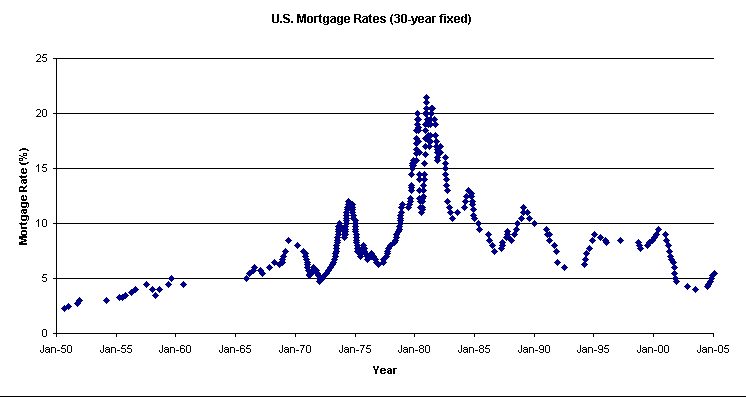
Historical Context
2 moments from history that rhyme with this story — and how they unfolded.
1 of 2
April 2024
The 7.5% spike of April 2024
Thirty-year rates last held at 7.5% in April 2024, the prior peak before this week. They then eased through late 2024 and 2025, reaching about 6% by late February 2026.
Then
Buyers saw affordability relief as rates drifted lower over 2025.
Now
The decline fully reversed this fall, with rates climbing from 6% to 7.58% in seven months.
Why this matters now
Shows that a 7.5% level is not permanent, but also how quickly the reprieve eroded once inflation and bond-market pressure returned.
2 of 2
2007
2007: The last time yields topped 5%
The 10-year Treasury last yielded above 5% in 2007, the year the housing market began to crack. It closed at 5.24% on Monday, the first time back at that level.
Then
Yields at this level in 2007 came amid a deteriorating housing market.
Now
The ensuing crisis brought rates to historic lows within a few years.
Why this matters now
The return to 5% yields shows how persistent the current inflation and borrowing-cost cycle has become, even though lending standards and Fed policy differ sharply from 2007.