

Pull to refresh
Logo
Daily Brief
Following
Why Sign Up
NASA builds its next flagship space telescope to map the dark universe

NASA builds its next flagship space telescope to map the dark universe

New Capabilities
By Newzino Staff |

The Nancy Grace Roman Space Telescope is fully assembled and on track for a fall 2026 launch

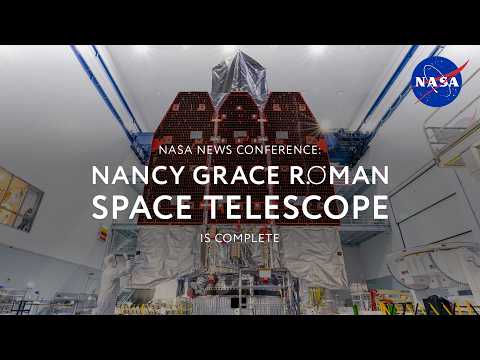
Today: NASA unveils the completed Roman Space Telescope

Overview

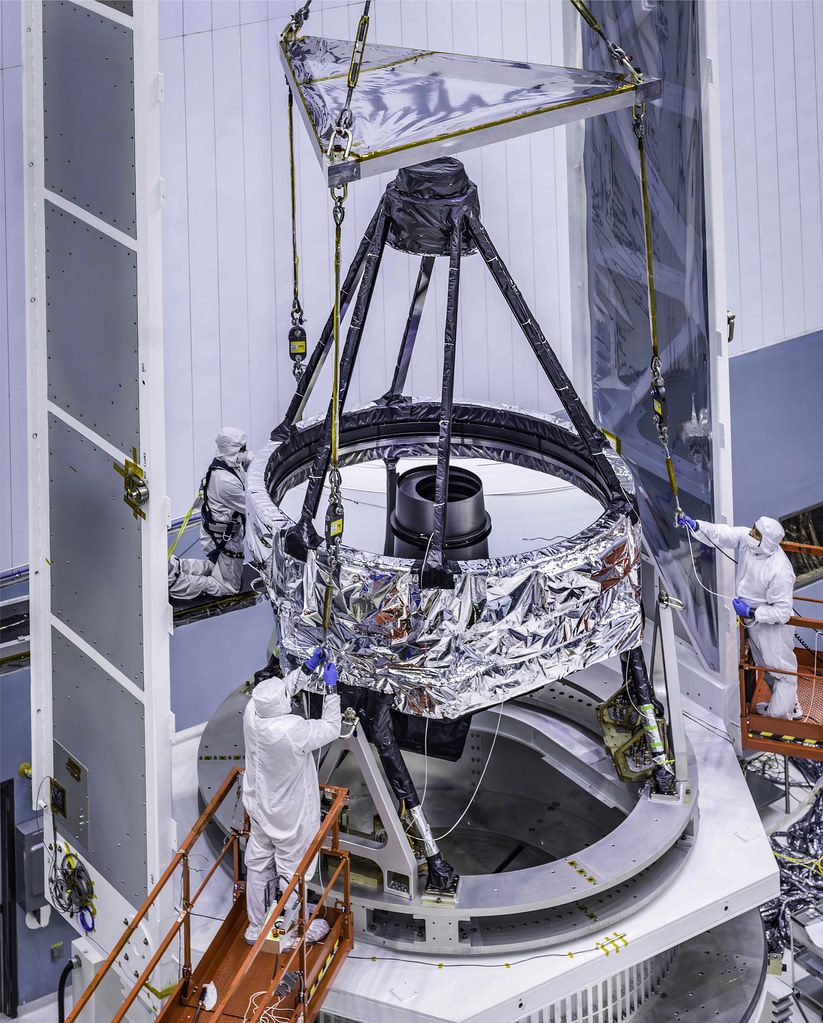
NASA's Nancy Grace Roman Space Telescope is fully built and ready for space. Unveiled on April 21, 2026, at NASA's Goddard Space Flight Center, the observatory carries a 300-megapixel infrared camera with a field of view 100 times wider than the Hubble Space Telescope's, designed to photograph a billion galaxies and discover more than 100,000 new worlds over its first five years.

Why it matters

Roman will survey the sky 1,000 times faster than Hubble, potentially revealing why the universe's expansion is accelerating.

Key Indicators

100x
Field of view vs. Hubble
Roman's wide-field camera captures 100 times more sky per image than Hubble, despite having the same 2.4-meter mirror.
1 billion
Galaxies to be surveyed
Roman will measure light from a billion galaxies over its mission lifetime to map the structure of the universe.
100,000+
Expected exoplanet discoveries
The telescope's microlensing survey is expected to reveal more than 100,000 distant worlds, including free-floating planets.
$4.3B
Estimated mission lifecycle cost
Total cost including development, launch on SpaceX Falcon Heavy ($255 million), and five years of operations.
4
Cancellation attempts survived
Congress restored Roman's funding four times after presidential budget proposals tried to eliminate the mission.

Interactive

Exploring all sides of a story is often best achieved with Play.

Ever wondered what historical figures would say about today's headlines?

Sign up to generate historical perspectives on this story.

Sign Up

Debate Arena

Two rounds, two personas, one winner. You set the crossfire.

People Involved

Organizations Involved

Timeline

  1. NASA unveils the completed Roman Space Telescope

    Milestone

    NASA publicly unveils the fully assembled telescope at Goddard Space Flight Center in one of the last opportunities to view the observatory before it ships to Kennedy Space Center this summer for launch preparations.

  2. Full observatory assembly completed at Goddard

    Milestone

    Engineers at Goddard Space Flight Center finish integrating Roman's two major segments, completing the physical construction of the observatory.

  3. White House again proposes canceling Roman

    Budget

    The Trump administration's fiscal year 2026 budget proposal seeks to cut NASA's science budget from $7.5 billion to $3.9 billion and cancel the Roman Space Telescope along with dozens of other missions. Congress again rejects the cuts, funding Roman at $300 million.

  4. SpaceX wins Falcon Heavy launch contract

    Contract

    NASA awards SpaceX a $255 million contract to launch Roman on a Falcon Heavy rocket from Kennedy Space Center, with a readiness date of October 2026.

  5. NASA renames the telescope after Nancy Grace Roman

    Milestone

    NASA Administrator Jim Bridenstine announces that WFIRST will be called the Nancy Grace Roman Space Telescope, honoring the agency's first Chief of Astronomy and the driving force behind the Hubble Space Telescope.

  6. First presidential budget proposes canceling the telescope

    Budget

    The Trump administration's fiscal year 2019 budget proposal seeks to eliminate WFIRST funding. Congress rejects the cut and restores the mission's budget.

  7. NASA formally approves WFIRST for development

    Policy

    NASA greenlights the mission for full development and launch, moving it from concept studies into engineering and construction.

  8. National Reconnaissance Office donates spy satellite mirrors

    Development

    The National Reconnaissance Office transfers two surplus 2.4-meter telescope mirrors to NASA, reshaping the WFIRST design around hardware originally built for intelligence satellites.

  9. Decadal Survey ranks WFIRST as top priority

    Policy

    The National Academy of Sciences' 2010 Decadal Survey for Astronomy names the Wide Field Infrared Survey Telescope as the highest-priority large space mission for the coming decade.

Scenarios

1

Roman launches on schedule in fall 2026 and begins science operations

Discussed by: NASA project management, Space.com, SpaceNews — all note the team is tracking ahead of the May 2027 deadline

Roman ships to Kennedy Space Center this summer, completes final launch preparations, and lifts off aboard Falcon Heavy by late 2026. After a month-long journey to the Sun-Earth L2 point and a commissioning period, the telescope begins its wide-field surveys in early 2027. First science images could arrive by spring 2027, generating public excitement comparable to Webb's first deep field.

2

Technical issues or budget uncertainty push launch to mid-2027

Discussed by: Congressional budget analysts, Planetary Society — note that while construction is done, final testing and political headwinds could cause delays

Environmental testing at Goddard or launch preparations at Kennedy reveal issues that require rework, or renewed budget pressure from the executive branch slows operational funding. The launch slips to the contractual deadline of May 2027 or slightly beyond. The science mission is unaffected long-term, but the delay narrows the window before Roman's data overlaps with the European Space Agency's Euclid mission results.

3

Roman and Euclid together crack the dark energy puzzle

Discussed by: NASA and the European Space Agency in joint planning documents, astrophysicists publishing combined-survey forecasts

Roman's deep, high-resolution infrared surveys complement Euclid's wide-area mapping to produce the most precise measurements of dark energy ever achieved. Combined with JWST follow-up observations, the data either confirms the standard cosmological model or reveals that dark energy changes over time, opening an entirely new chapter in physics. The overlap of all three observatories operating simultaneously from roughly 2027 to 2029 represents an unprecedented window for cosmology.

4

Roman's coronagraph succeeds, accelerating the search for habitable worlds

Discussed by: Jet Propulsion Laboratory, Habitable Worlds Observatory planning teams, National Academies

The Coronagraph Instrument, a technology demonstration built by JPL, achieves its goal of suppressing starlight by a factor of a billion, directly imaging giant exoplanets around nearby stars for the first time from space. The success validates the core technology needed for NASA's planned Habitable Worlds Observatory, a future flagship telescope designed to photograph Earth-like planets and search for signs of life, potentially accelerating its development timeline from the 2040s.

Historical Context

Hubble Space Telescope (1990)

April 1990

What Happened

NASA launched the Hubble Space Telescope after two decades of development and political battles over its funding. Within weeks, astronomers discovered a flaw in its primary mirror that produced blurry images, threatening the entire $1.5 billion mission. A 1993 servicing mission by Space Shuttle astronauts installed corrective optics that fixed the problem.

Outcome

Short Term

The mirror flaw became a public embarrassment for NASA, but the successful repair mission restored confidence and demonstrated the value of serviceable space hardware.

Long Term

Hubble became one of the most productive scientific instruments ever built, operating for more than 35 years and fundamentally reshaping humanity's understanding of the universe. It proved that flagship space telescopes, despite enormous costs and political risk, deliver transformative science.

Why It's Relevant Today

Roman carries the same 2.4-meter mirror size as Hubble and was championed by the same woman who made Hubble possible. Its long, politically fraught path to the launch pad mirrors Hubble's own struggle for survival, and its scientific ambitions are a direct extension of questions Hubble first raised about the expanding universe.

James Webb Space Telescope (2021)

December 2021

What Happened

After 25 years of development, repeated cost overruns that pushed its price tag from $1 billion to $10 billion, and multiple near-cancellations by Congress, NASA launched the James Webb Space Telescope on Christmas Day 2021. The observatory's complex unfolding sequence, involving 344 single points of failure, worked flawlessly.

Outcome

Short Term

Webb's first images in July 2022 revealed the deep universe in unprecedented infrared detail, generating worldwide public excitement and immediately producing new science.

Long Term

Webb proved that even the most troubled, over-budget flagship missions can deliver extraordinary returns. It also set an operational precedent at the Sun-Earth L2 point, the same destination Roman will occupy.

Why It's Relevant Today

Roman benefits directly from lessons learned during Webb's troubled development. NASA restructured its project management and cost estimation practices after Webb's overruns. Roman's relatively smooth path through construction, arriving on schedule and closer to budget, reflects those institutional reforms. The two telescopes will operate from the same orbital neighborhood and are designed to work in tandem.

European Space Agency's Euclid mission (2023)

July 2023

What Happened

The European Space Agency launched Euclid, a space telescope specifically designed to map the geometry of the dark universe by surveying billions of galaxies across one-third of the sky. NASA contributed infrared detectors and hundreds of scientists to the mission.

Outcome

Short Term

Euclid began producing wide-area survey data, releasing its first science results and images showing vast cosmic structures in unprecedented panoramic detail.

Long Term

Euclid is building the largest three-dimensional map of the universe ever attempted, establishing a baseline dataset that Roman's deeper observations will complement and cross-check.

Why It's Relevant Today

Roman and Euclid are designed as complementary missions tackling the same fundamental questions from different angles. Euclid surveys a wide, shallow field; Roman goes narrow and deep. Together they form a one-two punch that cosmologists say will be far more powerful than either telescope alone for constraining dark energy models.

Sources

(12)