
Pull to refresh
Logo
NASA awards PlanetiQ $3.3 million for precipitation and space weather data

NASA awards PlanetiQ $3.3 million for precipitation and space weather data

New Capabilities

Latest in a series of government contracts for the Colorado satellite data company

2 days ago: NASA awards $3.3 million task order for GNSS-PRO and TEC data

Overview

Updated 1 hour ago

NASA has agreed to buy polarimetric radio occultation and ionospheric data from PlanetiQ, a Golden, Colorado company, in a $3.3 million task order. The data will give NASA researchers a new way to measure precipitation and space weather from orbit.

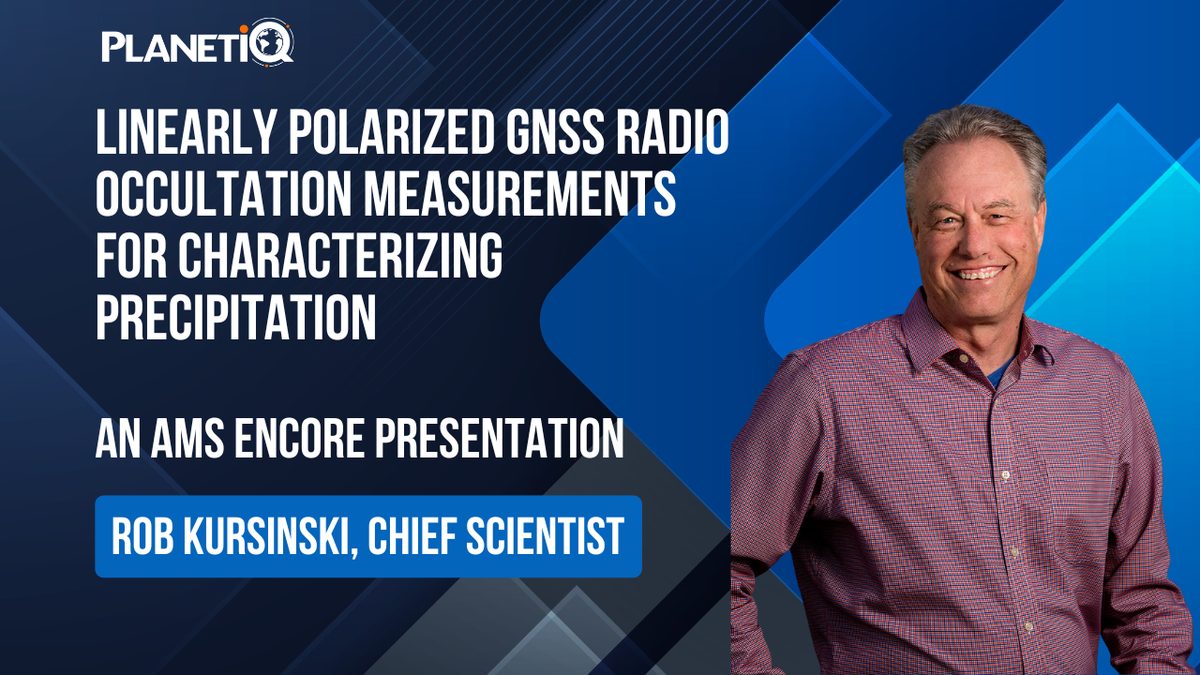
Radio occultation works by tracking how navigation satellite signals bend and slow as they pass through Earth's atmosphere. PlanetiQ's polarimetric version adds horizontal and vertical signal measurements, which reveal rain and snowfall because flattened raindrops affect the two polarizations differently.

The award is the latest in a string of government contracts for PlanetiQ. In September, NOAA committed $28.4 million for the company's radio occultation data. NASA's evaluation in January rated PlanetiQ's total electron content precision 'best-in-class.'

Why it matters

Government weather agencies are shifting from building satellites to buying data, and PlanetiQ's new technique could improve precipitation forecasting worldwide.

Questions about this story

Free account needed to ask — your question is kept and asked for you right after sign-up. Answers are public.

No questions yet — be the first to ask.

Key Indicators

$3.3M
NASA task order value
For GNSS-PRO and ionospheric TEC data through the Commercial Satellite Data Acquisition program.
$28.4M
NOAA contract value
For 4,200 GNSS-RO profiles and 500 TEC tracks per day over 24 months.
4,200
GNSS-RO profiles per day
Under the NOAA contract, of which 700 have temporal resolution enhancements.
500
TEC tracks per day
Low-latency ionospheric measurements under the NOAA contract.

Voices

Curated perspectives — historical figures and your fellow readers.

Ever wondered what historical figures would say about today's headlines?

Sign up to generate historical perspectives on this story.

People Involved

Organizations Involved

Timeline

January 2026 October 2026

4 events Latest: 2 days ago
Tap a bar to jump to that date
  1. NASA awards $3.3 million task order for GNSS-PRO and TEC data

    Latest Contract

    NASA's CSDA program awarded PlanetiQ a $3.3 million task order for polarimetric radio occultation and ionospheric TEC data, providing researchers with high-SNR observations of precipitation and the ionosphere.

  2. NOAA awards PlanetiQ $28.4 million for radio occultation and TEC data

    Contract

    NOAA's Commercial Data Program awarded $67 million total to PlanetiQ, Spire Global, and Ethereal for 10,000 RO profiles and 500 TEC measurements per day. PlanetiQ's share: 4,200 profiles and 500 TEC tracks daily.

  3. NASA expands PlanetiQ contract to add polarimetric radio occultation data

    Contract

    NASA's CSDA program added high-SNR GNSS polarimetric radio occultation data to PlanetiQ's existing offerings of ionospheric scintillation, TEC, and GNSS-RO data.

  4. NASA CSDA rates PlanetiQ's radio occultation data 'best-in-class'

    Evaluation

    A one-year independent NASA evaluation rated PlanetiQ's total electron content precision 'best-in-class' and called its high signal-to-noise ratio a 'unique value proposition.'

Scenarios

1

PlanetiQ's PRO data enters operational weather models

Possible Resolves by End of 2028

Discussed by: NOAA NESDIS, NASA CSDA

If the polarimetric radio occultation data proves valuable in research, NOAA could begin assimilating it into operational numerical weather prediction models. This would validate the technique and expand PlanetiQ's market beyond research. NOAA already uses standard GNSS-RO data in its models; PRO data would add precipitation information those models currently lack.

2

PlanetiQ wins expanded government contracts

Likely Resolves by End of 2027

Discussed by: NASA CSDA, NOAA CDP

Given the 'best-in-class' rating and the expanding NOAA contract, PlanetiQ could win additional or larger contracts as the PRO capability matures and more satellites come online. The company's data already fills coverage gaps where COSMIC-2 observations are unavailable, and NASA noted its data supports national security missions.

3

Rivals match PlanetiQ's polarimetric RO capability

Possible Resolves by End of 2027

Discussed by: NASA CSDA evaluation, industry observers

Spire Global and Ethereal also won NOAA contracts in September. If either develops polarimetric radio occultation capability, PlanetiQ's competitive edge narrows. NASA's evaluation noted PlanetiQ's data outperformed 'commercial competitor datasets,' but that advantage depends on being the only provider of PRO data.

Historical Context

2 moments from history that rhyme with this story — and how they unfolded.

2006

COSMIC/FORMOSAT-3 (2006)

The Taiwan-US COSMIC mission launched six satellites with GNSS radio occultation receivers, the first operational constellation of its kind. The satellites measured how navigation signals bend through the atmosphere, producing temperature and moisture profiles used in weather models worldwide.

Then

The data improved hurricane track forecasts and global weather prediction within months of launch.

Now

COSMIC proved radio occultation's value and set the standard for the technique commercial providers now use.

Why this matters now

COSMIC demonstrated the scientific value of the data PlanetiQ now sells commercially.

2019

COSMIC-2/FORMOSAT-7 (2019)

The follow-on COSMIC-2 mission launched six satellites focused on low-latitude coverage, providing more frequent observations of tropical weather and the ionosphere.

Then

Expanded radio occultation coverage over the tropics, improving hurricane and space weather monitoring.

Now

Showed coverage gaps that commercial providers like PlanetiQ now fill.

Why this matters now

NASA's evaluation noted PlanetiQ's data fills gaps where COSMIC-2 observations are unavailable.

Sources

(6)