
Pull to refresh
Logo
Daily Brief
Following
Why
Trump builds selective Latin American military coalition to fight cartels and counter China

Trump builds selective Latin American military coalition to fight cartels and counter China

Force in Play
By Newzino Staff |

The 'Shield of the Americas' brings 12 ideologically aligned nations together while the region's three largest economies stay away

Yesterday: Shield of the Americas summit launches counter-cartel coalition

Overview

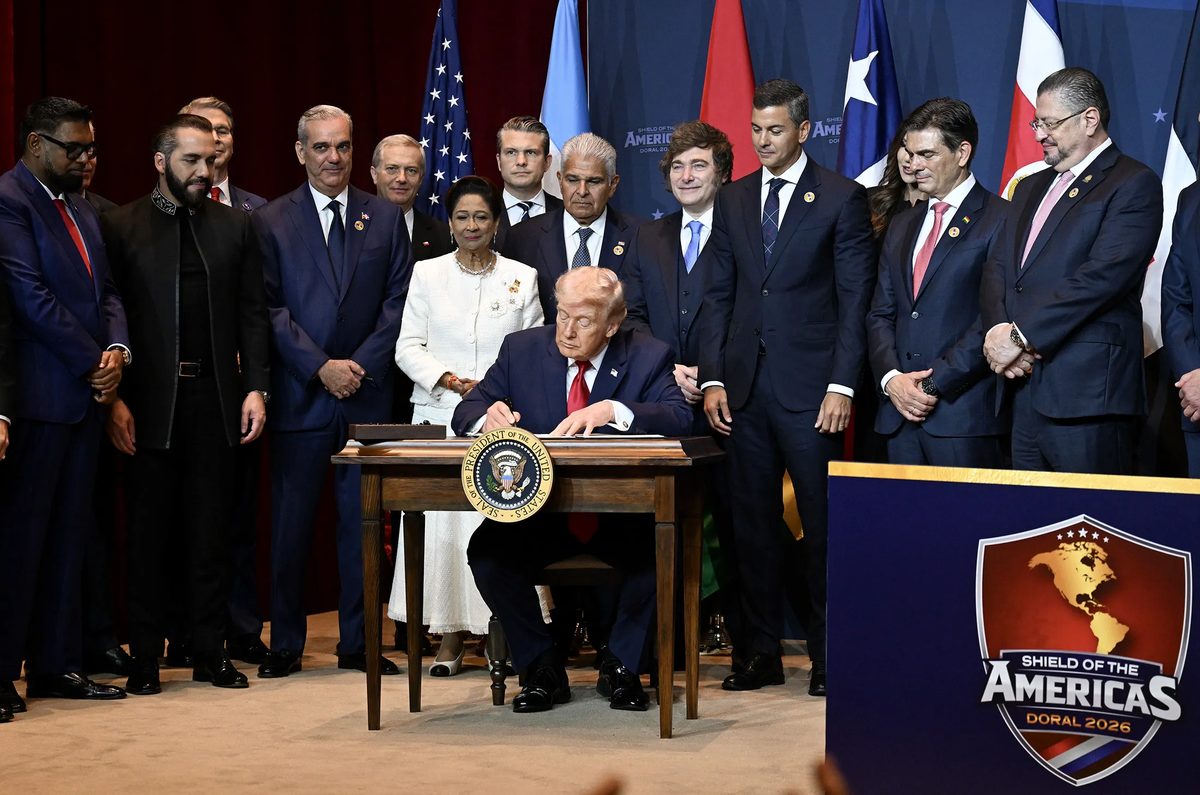
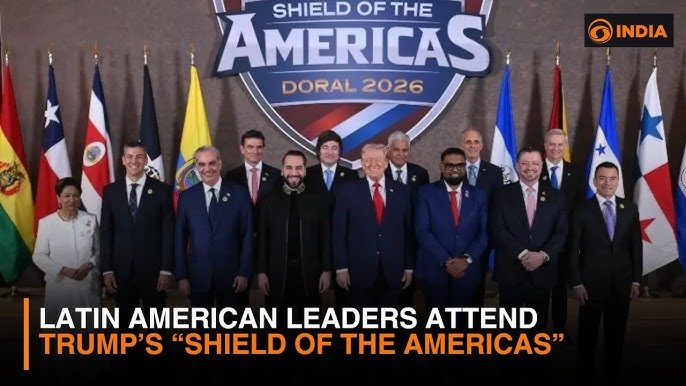
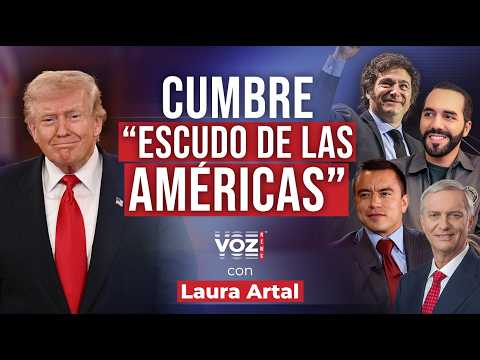
The United States has not built a new military coalition in the Western Hemisphere since the Cold War. On March 7, President Trump gathered leaders from 12 Latin American nations at his Doral resort in Miami to launch the 'Shield of the Americas,' a framework for coordinated military and intelligence operations against drug cartels, and announced the Americas Counter-Cartel Coalition, a pledge from 17 countries to use lethal military force against transnational criminal organizations.

Key Indicators

12
Nations at summit
Latin American countries whose leaders attended the Doral gathering
17
Coalition signatories
Countries that signed the Americas Counter-Cartel Coalition pledge
3
Major absentees
Mexico, Brazil, and Colombia—the region's three largest economies—did not attend
151+
Killed in vessel strikes
Deaths from 44 U.S. airstrikes on alleged drug boats since September 2025

Interactive

Exploring all sides of a story is often best achieved with Play.

Ever wondered what historical figures would say about today's headlines?

Sign up to generate historical perspectives on this story.

Sign Up

Debate Arena

Two rounds, two personas, one winner. You set the crossfire.

People Involved

Donald Trump
Donald Trump
President of the United States (Hosted summit, announced coalition)
Marco Rubio
Marco Rubio
U.S. Secretary of State (Led diplomatic track of summit)
Kristi Noem
Kristi Noem
Special Envoy for Shield of the Americas; former Secretary of Homeland Security (Appointed to newly created envoy role days after removal from DHS)
Javier Milei
Javier Milei
President of Argentina (Attended summit; close Trump ally)
Nayib Bukele
Nayib Bukele
President of El Salvador (Attended summit; seen as model for military anti-gang approach)
Pete Hegseth
Pete Hegseth
U.S. Secretary of War (Defense) (Overseeing military operations and coalition structure)

Organizations Involved

Americas Counter-Cartel Coalition
Multinational Military Coalition
Status: Formally launched March 7, 2026

A coalition of 17 Western Hemisphere nations pledging to use military force against drug cartels and transnational criminal organizations designated as foreign terrorist organizations by the United States.

Center for Strategic and International Studies
Think Tank
Status: Published analysis of summit and counter-China strategy

A Washington-based policy research organization that has provided detailed analysis of the Shield of the Americas gathering and its implications for countering Chinese influence in the Western Hemisphere.

Timeline

  1. Shield of the Americas summit launches counter-cartel coalition

    Diplomatic

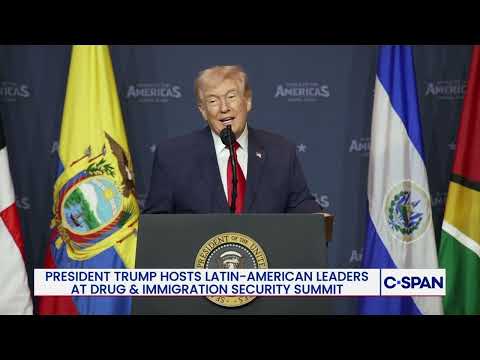
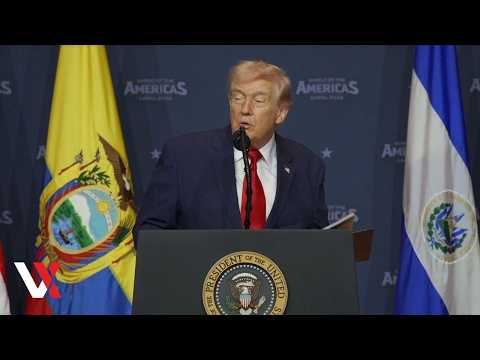
    Trump hosted leaders from 12 Latin American nations at his Doral resort to formally launch the Shield of the Americas framework. He announced the Americas Counter-Cartel Coalition, urged participating nations to deploy military force against cartels, and warned of imminent action against Cuba. Mexico, Brazil, and Colombia were absent.

  2. Counter Cartel Conference convenes with 17 nations' military leaders

    Diplomatic

    Secretary of War Hegseth hosted military leaders and representatives from 17 countries at a conference where they signed the Americas Counter-Cartel Coalition pledge, laying the groundwork for the Shield of the Americas summit two days later.

  3. Noem removed from DHS, named Shield of the Americas envoy

    Personnel

    Trump removed Kristi Noem as Secretary of Homeland Security and appointed her to the newly created position of Special Envoy for the Shield of the Americas. Senator Markwayne Mullin was named as her DHS successor.

  4. Trump invokes 'Donroe Doctrine'

    Statement

    In a press conference referencing the Maduro capture, Trump claimed his administration had 'superseded' the Monroe Doctrine and coined the term 'Donroe Doctrine' to describe his assertion of U.S. authority over hemispheric affairs.

  5. U.S. military captures Venezuelan President Maduro

    Military

    In Operation Absolute Resolve, Delta Force operators seized President Nicolás Maduro from his residence in Caracas. He was transported to the United States to face criminal charges. Vice President Delcy Rodríguez was sworn in as interim president two days later.

  6. National Security Strategy introduces 'Trump Corollary' to Monroe Doctrine

    Policy

    The administration released its National Security Strategy, asserting a 'Trump Corollary' to the Monroe Doctrine that pledges to deny 'non-Hemispheric competitors' the ability to position forces or control strategic assets in the Western Hemisphere—language aimed at China.

  7. Caribbean strike campaign named Operation Southern Spear

    Military

    Secretary of War Hegseth formally named the ongoing campaign of airstrikes against alleged drug trafficking vessels. By this point, strikes had expanded from the Caribbean into the eastern Pacific Ocean.

  8. Trump notifies Congress of 'non-international armed conflict'

    Legal

    The president formally notified Congress that the United States was engaged in a non-international armed conflict with 'unlawful combatants' in the Caribbean, providing a legal framework for continued military strikes.

  9. First U.S. airstrike on alleged drug vessel in Caribbean

    Military

    The U.S. military struck a vessel off the coast of Venezuela, killing all 11 people aboard. Trump announced the strike the following day, marking the start of a sustained campaign of airstrikes against alleged narcotics traffickers at sea.

  10. Eight cartel designations take effect

    Legal

    Foreign terrorist organization designations took effect for eight groups including the Sinaloa Cartel, Jalisco New Generation Cartel, Tren de Aragua, and MS-13, making it a federal crime to provide them material support.

  11. Trump designates cartels as foreign terrorist organizations

    Policy

    On his first day back in office, Trump signed an executive order directing the State Department to designate major drug cartels and transnational criminal organizations as Foreign Terrorist Organizations and Specially Designated Global Terrorists.

Scenarios

1

Coalition produces coordinated operations that measurably disrupt cartel networks

Discussed by: Trump administration officials, supportive analysts at the National Interest and Heritage Foundation

If participating nations follow through on intelligence sharing and joint military operations, the coalition could replicate at a regional scale what El Salvador achieved domestically—visible, rapid disruption of criminal organizations. This would require sustained funding, operational coordination across 17 countries, and cooperation from at least some of the absent nations, particularly Colombia, which controls the primary cocaine production territory. Success would validate the military-first approach and likely accelerate similar coalitions elsewhere.

2

Absent nations form parallel track, fragmenting hemispheric security

Discussed by: Chatham House analysts, CSIS Western Hemisphere program, Responsible Statecraft

Mexico, Brazil, and Colombia—representing the bulk of the region's population, economy, and narcotics geography—could deepen alternative partnerships with China and each other, creating a competing bloc. Brazil's President Lula has already expanded ties with Beijing, and Colombia's traditional role as the lynchpin of U.S. counter-narcotics strategy is at risk. This scenario would leave the coalition controlling the periphery while the center of the drug trade operates outside its reach.

3

Military operations produce civilian casualties or sovereignty backlash, coalition fractures

Discussed by: Center for American Progress, Just Security legal scholars, affected governments' public statements

The vessel strike campaign has already drawn accusations that many of those killed were civilians, primarily fishermen. If coalition operations expand overland and produce documented civilian harm or provoke sovereignty concerns among participating nations facing domestic pressure, smaller members could withdraw or reduce cooperation. Ecuador and Honduras, both facing internal political instability, are considered most vulnerable to this dynamic.

4

Coalition becomes primarily an anti-China instrument, narcotics mission fades

Discussed by: Peterson Institute for International Economics, Atlantic Council, Brookings Institution

The summit's dual mandate—fighting cartels and countering China—may evolve so that the anti-China dimension dominates, particularly as participating nations negotiate trade deals that exclude Chinese companies from ports, telecommunications, and critical minerals. If this occurs, the coalition could transform into a hemispheric trade and investment bloc aligned with U.S. economic interests, with the counter-cartel framing serving as political cover for what is essentially a containment strategy.

Historical Context

Plan Colombia (2000–2015)

2000–2015

What Happened

The Clinton administration and Colombian President Andrés Pastrana launched a $10 billion aid program aimed at cutting cocaine production by 50% in six years and defeating left-wing insurgent groups. Roughly 71% of U.S. funding went to military and police assistance, making it the largest U.S. security commitment in Latin America since the Cold War.

Outcome

Short Term

The Colombian military drove the FARC guerrillas from much of their territory and killed over two dozen of their leaders. FARC membership fell from an estimated 17,000 to under 8,000.

Long Term

Cocaine production results were contested—U.S. reports claimed a 72% reduction while United Nations data showed no significant change. Colombia eventually negotiated a peace deal with the FARC in 2016, shifting to a political resolution after 15 years of military action.

Why It's Relevant Today

Plan Colombia was bilateral and focused on a single country with sustained funding over 15 years. The Shield of the Americas attempts something far more ambitious—multilateral military coordination across 17 nations—but without the participation of Colombia itself, which remains the hemisphere's primary cocaine producer.

Inter-American Treaty of Reciprocal Assistance / Rio Treaty (1947)

September 1947

What Happened

Nineteen Western Hemisphere nations, including the United States, signed the first codified multilateral security agreement in the Americas. The treaty established that an attack on one member would be considered an attack on all—a principle later invoked during the 1962 Cuban Missile Crisis to provide unanimous backing for the U.S. naval blockade of Cuba.

Outcome

Short Term

The treaty was invoked repeatedly during the 1950s and 1960s to justify collective action against perceived communist threats in the hemisphere.

Long Term

The treaty gradually lost relevance as Latin American nations questioned its use as a vehicle for U.S. intervention. Mexico withdrew in 2002, and Bolivia, Ecuador, Nicaragua, and Venezuela followed. By 2025, analysts described it as effectively defunct.

Why It's Relevant Today

The Shield of the Americas represents the first attempt to build a new multilateral military framework in the hemisphere since the Rio Treaty. But where the Rio Treaty included all regional powers and required unanimous action, the Shield coalition is deliberately selective—enrolling aligned governments and excluding opponents—a fundamentally different model of hemispheric security.

Reagan's Central America policy (1981–1989)

1981–1989

What Happened

The Reagan administration funneled military aid, training, and covert support to governments and armed groups across Central America to counter Soviet and Cuban influence. The United States backed the Contras against Nicaragua's Sandinista government, supported El Salvador's military against leftist insurgents, and trained Honduran forces as a regional staging base—all framed as hemispheric security.

Outcome

Short Term

The policy contained leftist movements militarily but produced widespread civilian casualties, human rights abuses, and the Iran-Contra scandal, which revealed illegal arms sales to fund the operations.

Long Term

The conflicts ended through negotiated peace accords in the early 1990s, not military victory. The era left deep distrust of U.S. military involvement across Latin America that persists today.

Why It's Relevant Today

Like the Reagan-era coalitions, the Shield of the Americas relies on ideologically aligned governments and frames the threat in existential terms—cartels and China rather than communism. The absence of Mexico, Brazil, and Colombia echoes how key regional actors in the 1980s resisted alignment, and the question of whether military force alone can resolve transnational security challenges remains unresolved.

Sources

(15)