
Pull to refresh
Logo
First feathers discovered in 66-million-year-old dinosaur dung

First feathers discovered in 66-million-year-old dinosaur dung

New Capabilities

The coprolite holds a mix of modern and primitive plumage, offering a new clue to why some birds survived the asteroid strike while others died out.

September 10th, 2026: Study published in Current Biology

Overview

Updated 2 hours ago

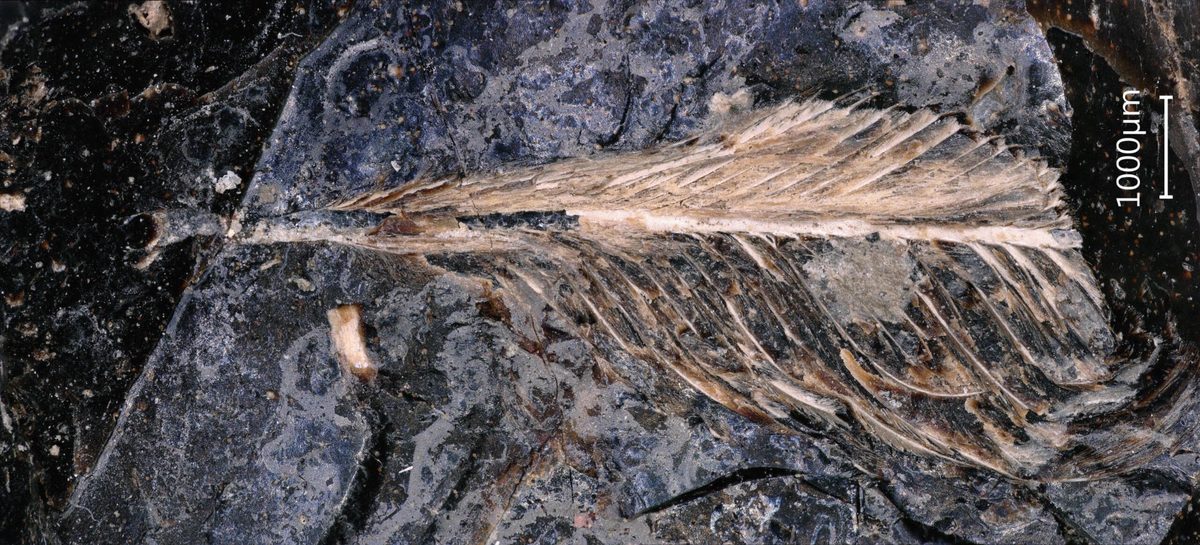
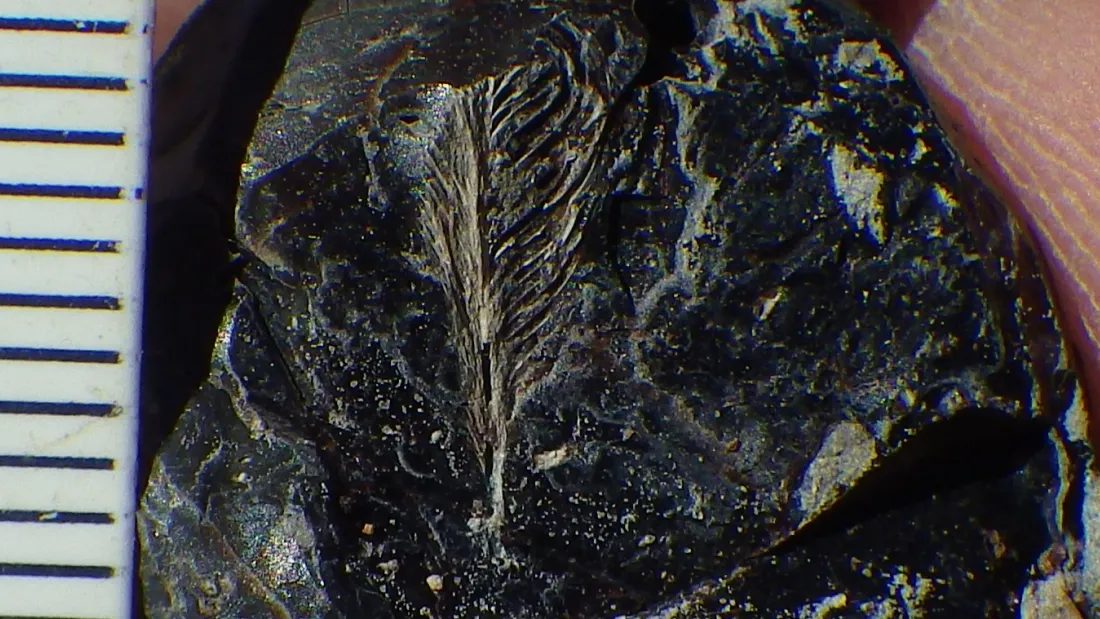
For the first time, scientists have found fossilized feathers inside dinosaur dung. The 66-million-year-old coprolite, unearthed in Montana, contains a wing feather, fluffy body feathers, bone fragments, and fish scales from an extinct aquatic bird called a hesperornithiform.

The feathers are a mix of modern and primitive types. That mix may explain why some bird lineages survived the asteroid impact that ended the dinosaurs' reign while others perished.

Why it matters

Understanding why some bird lineages survived the end-Cretaceous mass extinction reveals what traits protect species during sudden environmental collapse — and how modern birds came to dominate.

Questions about this story

Free account needed to ask — your question is kept and asked for you right after sign-up. Answers are public.

No questions yet — be the first to ask.

Key Indicators

66
Age in millions of years
The coprolite and its contents date to the end of the Cretaceous.
9.3 mm
Length of primary feather
One of the best-preserved Mesozoic feathers ever recovered.
1
First feather found in a coprolite
Feathers previously turned up in amber or rock, but never in fossilized dung.

Voices

Curated perspectives — historical figures and your fellow readers.

Ever wondered what historical figures would say about today's headlines?

Sign up to generate historical perspectives on this story.

People Involved

Organizations Involved

Timeline

June 2016 September 2026

2 events Latest: September 10th, 2026 · 2 weeks ago
  1. Study published in Current Biology

    Latest Publication

    Team led by Jingmai O'Connor reports first feathers in a coprolite, describing modern and primitive feather types inside a hesperornithiform.

  2. Coprolite discovered in Montana

    Discovery

    David DeMar Jr. finds a broken fossilized dropping with a feather visible on its surface.

Scenarios

1

Plumage hypothesis confirmed by more fossils

Possible Resolves by Sep 10, 2028

Discussed by: O'Connor and colleagues, Science News

Additional feathers from hesperornithiforms or enantiornithines found in other Late Cretaceous sites show primitive body feathers with weak insulation, directly supporting the idea that plumage drove extinction selectivity.

2

Alternative survival drivers gain traction

Possible Resolves by Sep 10, 2028

Discussed by: Critics and researchers, CNN and EL PAÍS

A subsequent study attributes bird survival to other factors — body size, diet, or habitat — and de-emphasizes plumage. The coprolite evidence is reinterpreted as a single data point rather than a pattern.

3

No further evidence emerges

Unlikely Resolves by Sep 10, 2028

Discussed by: N/A

No additional fossils or studies directly address the insulation hypothesis within two years. The finding remains a provocative but unconfirmed clue, and the scientific community moves on to other questions.

Historical Context

2 moments from history that rhyme with this story — and how they unfolded.

1861–1863

Archaeopteryx (1861)

A fossil from Germany showed a reptile-like skeleton with fully modern flight feathers, the first recognized transitional fossil between non-avian dinosaurs and birds.

Then

Archaeopteryx became a key piece of evidence for evolution, examined by Darwin and Huxley.

Now

It established the deep time of feather evolution and the utility of feathers as a diagnostic trait for the bird lineage.

Why this matters now

Just as Archaeopteryx bridged dinosaurs and birds, understanding hesperornithiform feather structure bridges the gap between primitive dinosaur coverings and modern bird plumage.

October 1996

Sinosauropteryx discovery (1996)

Paleontologists uncovered a small theropod dinosaur in China's Liaoning Province with clear impressions of filamentous feathers. It was the first non-avian dinosaur found with feather-like integument.

Then

The discovery ignited debate about the dinosaur-bird link and led to intensive quarrying in Liaoning, yielding many feathered species.

Now

It established that feathers predate birds, and that many dinosaurs bore them, reshaping the evolutionary tree.

Why this matters now

The new coprolite feathers show that even extinct bird lineages had modern feather mechanics, similar to how Sinosauropteryx showed feathers weren't limited to birds.

Sources

(9)