
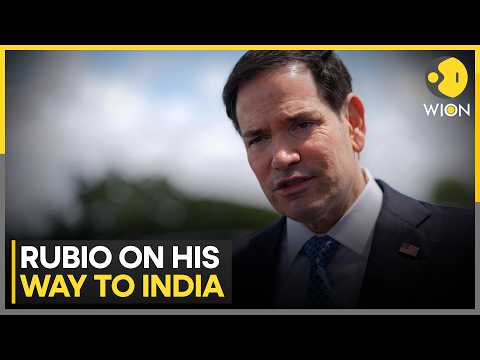
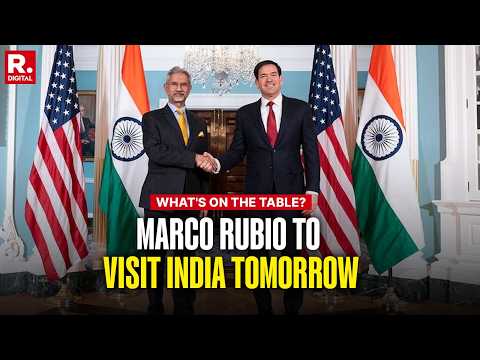
Rubio's first India visit anchors US push to reset strained ties
Rule ChangesQuad ministers in New Delhi sign critical minerals deal and commit to Fiji port as US-India trade deal nears
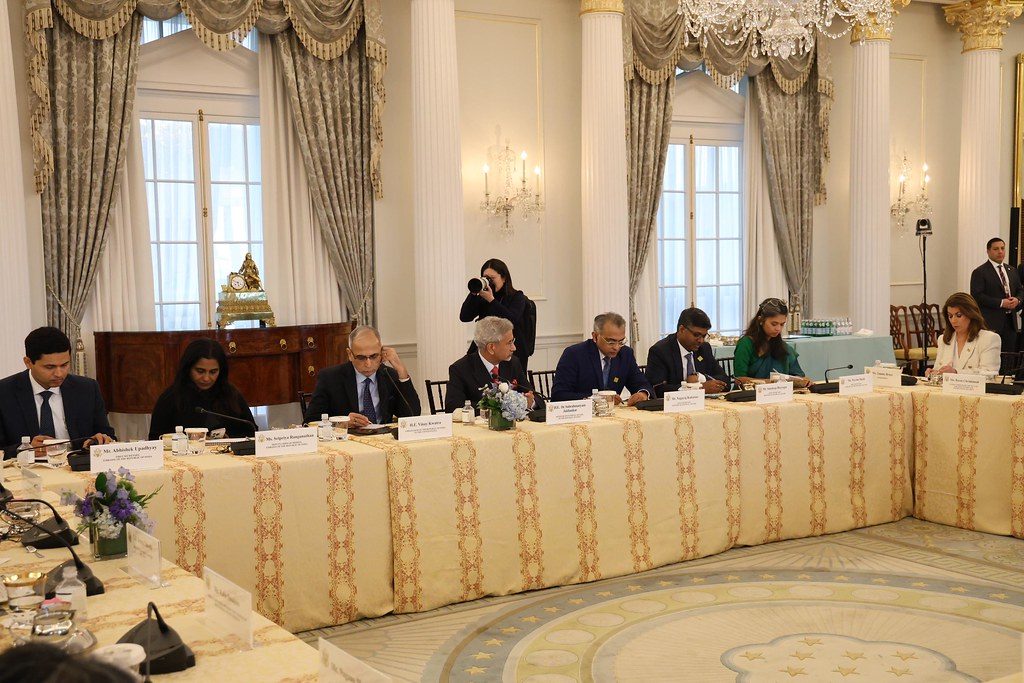
May 26th, 2026: Quad foreign ministers' meeting in New DelhiNew here? Follow stories to track developments over time. Create a free account to get updates when stories you care about change.
Overview
Updated May 26The Quad foreign ministers met in New Delhi on May 26 and produced three concrete agreements: a joint critical minerals framework, an Indo-Pacific maritime surveillance initiative, and the Quad's first joint infrastructure project — a port in Fiji. Rubio called the trade deal 'on the verge.'
The joint communique cited 'serious concern' about South China Sea militarization and condemned economic coercion without naming China. India is now signed into Pax Silica, the US-led critical minerals coalition. Russia remains the open risk: India's energy purchases still trigger the tariff mechanism, and any fresh penalty would unwind the reset.
Why it matters
If the reset holds, the world's largest democracy stays anchored to the US-led Indo-Pacific bloc; if it slips, China gains room and $48 billion in trade is in play.
Questions about this story
Free account needed to ask — your question is kept and asked for you right after sign-up. Answers are public.
No questions yet — be the first to ask.
Key Indicators
Voices
Curated perspectives — historical figures and your fellow readers.
Play
Exploring all sides of a story is often best achieved with Play.
Higher or Lower
A number from this story, against one from elsewhere in the news — guess which is bigger, then keep the chain going. 5 rounds, 3 strikes; a miss costs a strike and resets your streak.
Keyboard: ↓/L lower · ↑/H higher
0 points — sign up to put that on the leaderboard.
Timeline
Order five events from this story, oldest at top. Each in the right slot scores 1 — neighbours within one slot count too. Your previous result — green ✓ for exact slots, yellow ~ for off by one. Cards now in true chronological order.
Sign up to save your score and track a streak across stories.
Connections
Sixteen names from the news. Find the four hidden groups of four. Four mistakes max.
Sign up to keep a daily streak — a new puzzle lands every day.
Exit debate?
Your progress in this debate will be lost.
- 1 Two AI personas square off on this story.
- 2 You predict who'll win each round — correct picks earn XP.
- 3 One crossfire question is yours to fire. Pick it carefully.
Couldn't generate a topic
Select Your Champions
Choose one persona for each side of the debate
DEBATE TOPIC
Choose personas with different perspectives for a more dynamic debate.
Select debater for this side:
No debate personas available right now.
Select debater for this side:
No debate personas available right now.
Who's Got This Round?
Make your prediction before the referee scores
The referee scores both sides on
Round Results
Set the Crossfire
Pick the question both personas must answer in the final round
Debate Oracle! You called every round!
Sharp Instincts! You know your debaters!
The Coin Flip Strategist! Perfectly balanced!
The Contrarian! Bold predictions!
Inverse Genius! Try betting the opposite next time!
XP Breakdown
Prediction History
People Involved
Organizations Involved
Four-country grouping of the US, India, Japan and Australia focused on Indo-Pacific security and supply chains.
The US foreign affairs agency, currently anchoring the Indo-Pacific strategy through the Quad and the Pax Silica minerals initiative.
India's foreign ministry, balancing the US partnership with continued ties to Russia and managing the Quad chair role this year.
Timeline
August 2025 May 2026
-
Quad foreign ministers' meeting in New Delhi
Latest DiplomacyFirst Quad ministerial on Indian soil since March 2023. Critical minerals, supply chains and Indo-Pacific security lead the agenda.
-
Quad foreign ministers sign critical minerals framework and announce Fiji port project
DiplomacyThe four ministers finalized the Quad Critical Minerals Framework, signed a bilateral India-US deal covering mining through recycling of critical minerals and rare earths, and committed to a port in Fiji — the Quad's first joint infrastructure project. The joint statement cited 'serious concern' over South China Sea militarization.
-
Rubio-Jaishankar bilateral planned
DiplomacyTrade, energy security and critical minerals are on the agenda alongside Quad preparations.
-
Rubio and Jaishankar hold bilateral; trade deal described as 'on the verge'
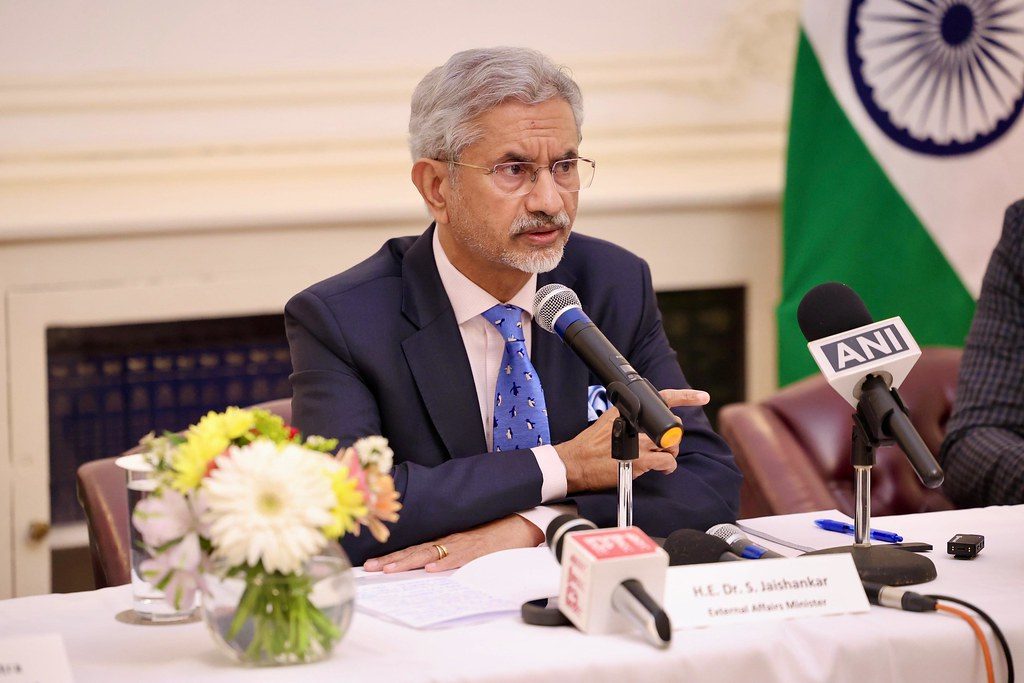
DiplomacyRubio and Jaishankar covered energy, trade, civil nuclear cooperation, and Indo-Pacific security. Rubio called the interim trade agreement 'on the verge' and said he hoped the US Trade Representative would visit India soon.
-
Rubio arrives in New Delhi
DiplomacyFirst India trip as Secretary of State. Includes a same-day call on Prime Minister Modi.
-
Trump and Modi agree on trade framework
DiplomacyA phone call sets terms for cutting the reciprocal tariff to 18% and removing the Russian-oil penalty, with India pledging $500 billion in US purchases over five years.
-
Rubio hosts Critical Minerals Ministerial
Diplomacy54 countries meet in Washington to coordinate on rare earths and processing capacity. India attends and is floated as a Pax Silica partner.
-
Trump's 50% tariff on India takes effect
TradeA 25% reciprocal tariff and a 25% penalty tied to India's Russian oil purchases hit roughly $48 billion of Indian exports.
-
India calls tariffs 'unjustified'
StatementNew Delhi rejects the Russian-oil linkage and warns the move risks decades of strategic alignment.
Historical Context
3 moments from history that rhyme with this story — and how they unfolded.
US-India Civil Nuclear Agreement (2005-2008)
President George W. Bush and Prime Minister Manmohan Singh announced a deal to end three decades of US nuclear isolation of India. Congress passed the Hyde Act in 2006 and the agreement was signed in October 2008, giving India access to civilian nuclear technology without joining the Non-Proliferation Treaty.
Opened US-India defense and technology trade and set the political foundation for the modern strategic partnership.
Treated as the moment the US chose India as a long-term Indo-Pacific partner. Every subsequent administration has built on it.
Shows what a true strategic reset looks like and how long it takes. Rubio's visit aims to repair the architecture the nuclear deal built before the 2025 tariff fight cracked it.
Revival of the Quad (2017)
On the sidelines of the East Asia Summit in Manila, officials from the US, India, Japan and Australia met to revive the Quadrilateral Security Dialogue after a decade of dormancy. The first Trump administration pushed the format as an Indo-Pacific counterweight to China.
Quad working groups stood up on maritime security, vaccines and technology.
By 2021 the Quad held its first leaders' summit. It is now the primary multilateral platform for Indo-Pacific democracies.
The Quad is the vehicle Rubio is using to anchor the reset. The 2017 revival shows the format can survive bilateral friction if the China rationale holds.
China-India Galwan Valley clash (2020)
Indian and Chinese troops fought hand-to-hand in the Galwan Valley along the disputed Himalayan border. Twenty Indian soldiers and at least four Chinese troops were killed in the worst border incident in 45 years.
India banned dozens of Chinese apps and froze Chinese investment screening rules.
Pushed India decisively into deeper Quad engagement and US defense cooperation.
Explains why India keeps coming back to the Quad table even after a year of tariff fights with Washington. The China threat is the gravity holding the alignment together.
