

Pull to refresh
Logo
Daily Brief
Following
Why Ranks Sign Up
Walmart trims profit outlook as tariff costs hit the retail bellwether

Walmart trims profit outlook as tariff costs hit the retail bellwether

Money Moves

The largest U.S. retailer signals limits on how much it can absorb

3 days ago: Walmart cuts FY27 profit guidance

Overview

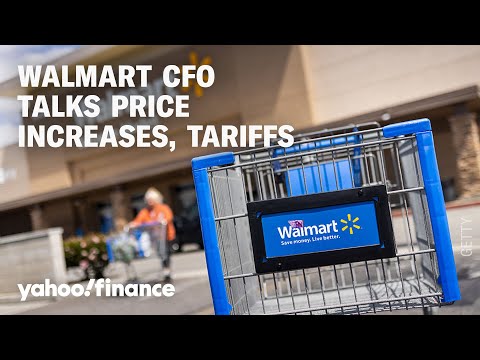
Walmart sells roughly one in four grocery dollars in the United States. On Wednesday it told investors that profit this fiscal year will land below what Wall Street expected, citing tariffs on imported general merchandise.

Revenue still grew 7.3% and eCommerce jumped 26%. The squeeze is on margins, not sales. Walmart's posture matters because it sets the price floor for the rest of retail — what Walmart passes to shoppers, Target and Kroger usually pass too.

Why it matters

Walmart is the price-setter for American retail. When its margins crack on tariffs, household grocery and apparel bills follow within months.

Key Indicators

7.3%
Q1 revenue growth
Total revenue growth year-over-year; 5.9% in constant currency.
26%
Global eCommerce growth
Online sales kept compounding even as profit guidance softened.
$2.75-$2.85
FY27 adjusted EPS guidance
Below the roughly $2.91 analyst consensus before the print.
~$2.91
Prior analyst consensus EPS
The figure Walmart's guidance came in below.
~1/3
Imported general merchandise share
Roughly a third of Walmart's general merchandise is imported, with China the largest single source.

Voices

Curated perspectives — historical figures and your fellow readers.

Ever wondered what historical figures would say about today's headlines?

Sign up to generate historical perspectives on this story.

Play

Exploring all sides of a story is often best achieved with Play.

Log in to play. Track your picks, climb the leaderboards. Log in Sign Up
Predict 4 ways this could play out. Contrarian picks score more — points lock when the scenario resolves. Log in to play
Higher or Lower Two numbers from this story. Guess which is bigger. 5 rounds to set a streak. Log in to play
Timeline Five events from this story — drag them oldest to newest. Log in to play
Connections Sixteen names from the news. Find the four hidden groups of four. Log in to play

People Involved

Organizations Involved

Timeline

February 2025 May 2026

5 events Latest: 3 days ago
Tap a bar to jump to that date
  1. Walmart cuts FY27 profit guidance

    Latest Earnings

    Reports 7.3% revenue growth and 26% eCommerce growth, but guides FY27 adjusted EPS to $2.75-$2.85, below the ~$2.91 consensus. Shares decline. Management cites tariff pass-through on imported general merchandise.

  2. Walmart Q4 FY26 results: margins narrow

    Earnings

    Full-year results show tariff drag on operating margin. Initial FY27 outlook is cautious but not yet cut.

  3. Walmart says it cannot absorb all tariff costs

    Statement

    On the Q1 FY26 call, McMillon and Rainey tell analysts some price increases are coming. Trump responds on social media, telling Walmart to absorb the costs.

  4. Broad reciprocal tariff package announced

    Policy

    Trump announces sweeping country-by-country tariffs. Retail industry groups warn of price increases within weeks.

  5. Trump imposes 10% tariff on Chinese imports

    Policy

    Initial second-term tariff order takes effect, raising landed cost on a large share of Walmart's general merchandise.

Historical Context

3 moments from history that rhyme with this story — and how they unfolded.

September 2018 - December 2019

First-term Trump tariffs and Walmart's pricing response (2018-2019)

Trump's first administration imposed tariffs on $250 billion of Chinese imports. Walmart filed a public letter warning the U.S. Trade Representative that prices would rise on bicycles, backpacks, hats, and Christmas lights. Walmart ultimately raised prices selectively and pushed suppliers to eat part of the cost.

Then

Walmart held grocery flat but raised prices on tariffed general merchandise categories. Margins were pressured but earnings still grew.

Now

Walmart accelerated supplier diversification out of China — by 2024 a smaller share of Walmart's imports came directly from Chinese factories than in 2017.

Why this matters now

The 2018 playbook — selective pass-through plus supplier pressure — is the template Walmart is running again, but the 2025 tariffs are broader and the absorption room is thinner.

May - August 2022

Walmart's 2022 inventory glut and consumer warning

Walmart cut profit guidance twice in three months, citing a sudden shift in consumer spending from discretionary goods to food and necessities. Inventory piled up on apparel and home, forcing markdowns.

Then

Shares fell, and the warning was treated as the first credible signal that pandemic-era consumer behavior was breaking.

Now

Walmart's grocery-anchored model was vindicated through the inflation cycle as higher-income shoppers traded down to its stores.

Why this matters now

Walmart's guidance cuts move broader retail expectations, not just its own stock. Today's print will be read the same way.

August 1971 - April 1974

Nixon-era price controls and retailer compliance (1971-1974)

Facing inflation, Nixon imposed a 90-day price freeze followed by years of phased controls. Retailers and manufacturers fought over who would absorb the squeeze when input costs rose but shelf prices were capped.

Then

Margins compressed across consumer goods. Shortages emerged in categories where producers refused to sell at controlled prices.

Now

Controls were abandoned by 1974 and contributed to the 1970s stagflation.

Why this matters now

Pressure from a president to hold prices down while input costs rise is not new. The historical lesson is that the squeeze eventually shows up somewhere — in margins, in shortages, or on the shelf.

Sources

(3)