
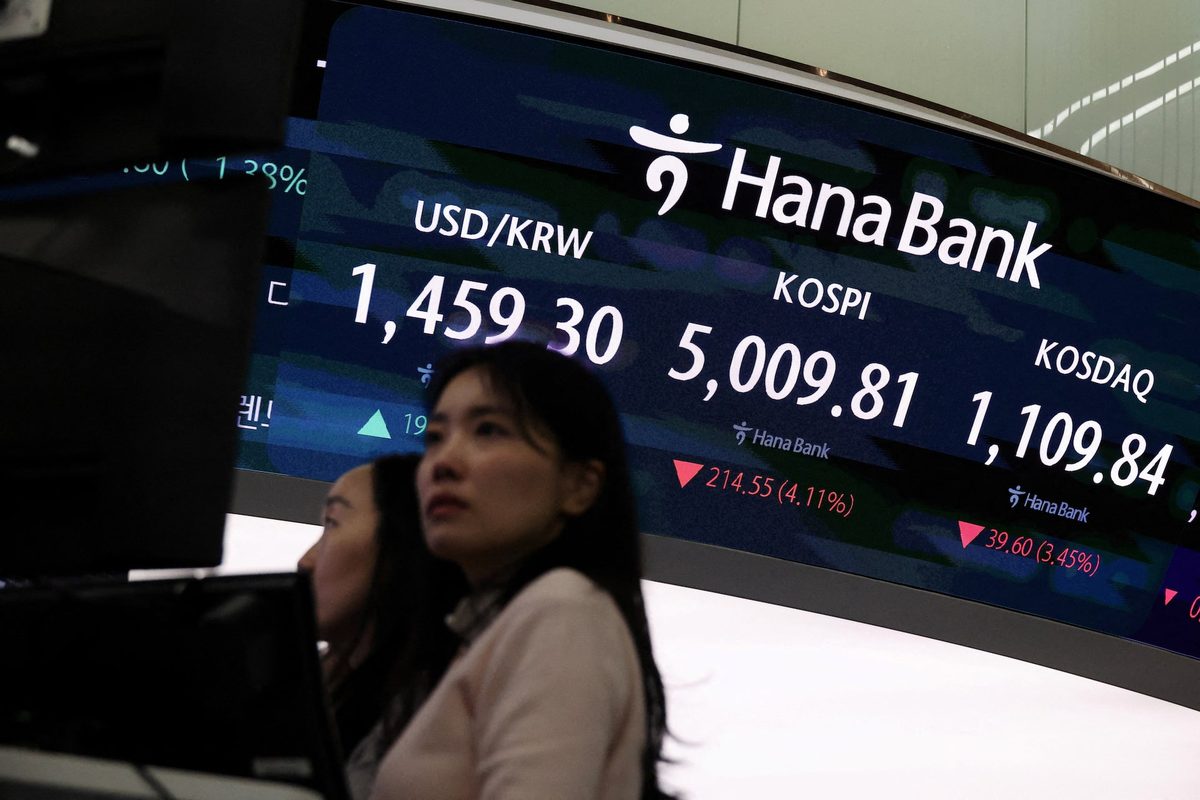
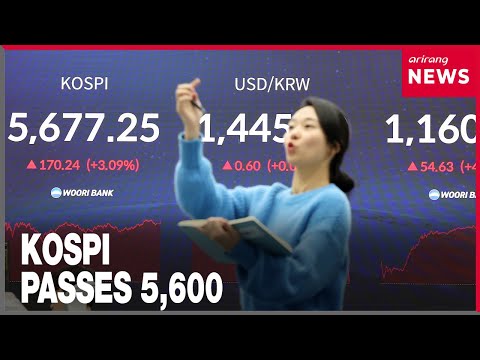
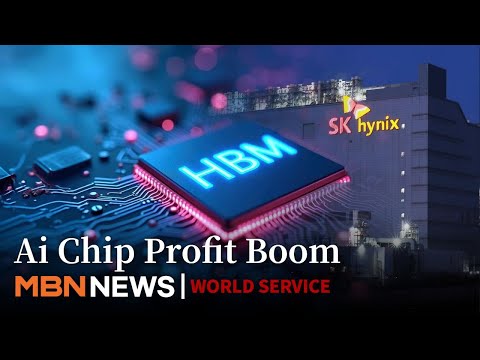
South Korea's benchmark KOSPI stock index crossed 6,000 points for the first time on February 25, 2026, completing its climb from 5,000 to 6,000 in just 34 trading days—the fastest thousand-point advance in the index's history. The index has gained 43% since January and 76% in 2025, making Seoul's market the best-performing major bourse in the world. Two companies explain most of the move: Samsung Electronics and SK Hynix, which together account for roughly 40% of the KOSPI's market capitalization and produce approximately 80% of the world's high-bandwidth memory (HBM) chips—the specialized components that artificial intelligence data centers cannot run without.
The rally reflects a structural shift in the global semiconductor industry. Every major technology company building AI infrastructure—from Nvidia to the hyperscale cloud providers—needs exponentially more memory per server, and the factories that make those chips are concentrated in South Korea. With all 2026 HBM production already sold out and memory prices rising 40–70%, Samsung and SK Hynix posted record profits in 2025. Simultaneously, South Korea's government has overhauled corporate governance laws to strengthen shareholder rights, narrowing the longstanding valuation gap that made Korean equities cheaper than global peers. The question now is whether this is a durable repricing of Korean assets or a concentration risk masquerading as a boom.
Click a figure to generate their perspective on this story
Debate Arena
Two rounds, two personas, one winner. You set the crossfire.
Choose Your Battle
Watch two AI personas debate this story using real evidence
Make predictions and set the crossfire to earn XP and cred
Select Your Champions
Choose one persona for each side of the debate
DEBATE TOPIC
SIDE A (PRO)
Select debater for this side:
✓
SIDE B (CON)
Select debater for this side:
✓
Choose personas with different perspectives for a more dynamic debate
VS
Get ready to make your prediction...
Round of
Claim
Evidence
Stakes
Crossfire Answer
Closing Statement
Claim
Evidence
Stakes
Crossfire Answer
Closing Statement
Your Crossfire Question
Generating arguments...
Who's Got This Round?
Make your prediction before the referee scores
Correct predictions earn +20 XP
Evidence
40%
Logic
30%
Detail
20%
Style
10%
Round Results
Your Pick!
+20 XP
Your Pick
Not this time
Evidence (40%)
Logic (30%)
Detail (20%)
Style (10%)
Overall Score
/10
Your Pick!
+20 XP
Your Pick
Not this time
Evidence (40%)
Logic (30%)
Detail (20%)
Style (10%)
Overall Score
/10
Set the Crossfire
Pick the question both personas must answer in the final round
Crafting crossfire questions...
Choosing a question earns +10 XP crossfire bonus
🏆
Total XP Earned
Cred Change
Predictions
Debate Oracle! You called every round!
Sharp Instincts! You know your debaters!
The Coin Flip Strategist! Perfectly balanced!
The Contrarian! Bold predictions!
Inverse Genius! Try betting the opposite next time!
XP Breakdown
Base completion+20 XP
Rounds played ( rounds x 5 XP)
+ XP
Correct predictions ( correct x 20 XP)
+ XP
Crossfire bonus+10 XP
Accuracy
%
Prediction History
Round
You picked:
✓✗
Keep debating to level up your credibility and unlock achievements
People Involved
Kwak Noh-Jung
President and Chief Executive, SK Hynix (Leading company through record-breaking performance)
Jun Young-hyun
Vice Chairman and Co-Chief Executive, Samsung Electronics (Device Solutions) (Leading Samsung's semiconductor recovery and HBM4 production ramp)
Lee Jae Myung
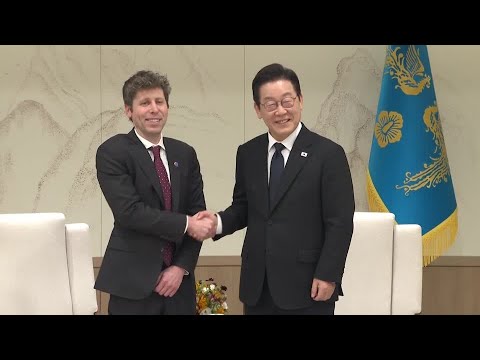
President of South Korea (Advancing corporate governance reforms and stock market development agenda)
Organizations Involved
SK
SK Hynix
Semiconductor Manufacturer
Status: World's largest high-bandwidth memory producer; all 2026 HBM capacity sold out
South Korea's second-largest chipmaker holds a dominant 62% share of global high-bandwidth memory shipments, making it the most critical supplier in the AI data center buildout.
SA
Samsung Electronics
Conglomerate / Semiconductor Manufacturer
Status: Largest KOSPI-listed company by market cap; ramping HBM4 production to close gap with SK Hynix
The world's largest memory chip maker by total volume is aggressively expanding AI chip production after falling behind SK Hynix in the race to qualify high-bandwidth memory with key customers.
KO
Korea Exchange (KRX)
Stock Exchange Operator
Status: Operating the world's best-performing major equity market
South Korea's sole securities exchange operator administers the KOSPI and KOSDAQ indices and has been implementing the government's Value Up program to attract global investors.
Timeline
KOSPI surpasses 6,000 for the first time
Market
The index reaches an intraday high of 6,144 and closes at 6,083, completing the fastest thousand-point advance in its history. SK Hynix's share price breaks through 1,000,000 won, and Samsung hits 200,000 won. Combined KOSPI market capitalization exceeds 5,000 trillion won (approximately $3.5 trillion).
Samsung posts record Q4 profit; announces HBM4 mass production
Earnings
Samsung Electronics reports Q4 operating profit of 20.1 trillion won, up 209% year-over-year, as memory prices surged 40–50%. The company announces it will begin mass shipments of HBM4 in February, closing the technology gap with SK Hynix.
SK Hynix surpasses Samsung in annual profit for the first time
Earnings
SK Hynix reports 2025 operating profit of 47.2 trillion won with a 49% operating margin, beating Samsung's semiconductor division for the first time in history. The result confirms SK Hynix's transformation from industry follower to leader in the AI memory era.
KOSPI crosses 5,000 for the first time
Market
The index clears another historic threshold, up 43% year-to-date in just three weeks of trading. Individual investors drive record buying in semiconductor stocks.
Samsung and SK Hynix seek 70% server memory price hikes
Industry
Both companies push for dramatic price increases on server DRAM for the first quarter of 2026, signaling that surging AI demand has flipped the memory market from buyer-controlled to seller-controlled.
KOSPI ends 2025 up 76%—its best year since 1999
Market
The index closes at 4,214 points, nearly doubling from its 2024 level. The annual gain of 75.6% makes it the strongest-performing major market globally, surpassing Japan's Nikkei 225 (up 26%) and the U.S. S&P 500.
SK Hynix reports record Q3; confirms all 2026 HBM capacity sold out
Earnings
SK Hynix posts record quarterly revenue and operating profit, driven by HBM3E sales that more than doubled. The company confirms demand is so strong that its entire 2026 production of high-bandwidth memory is already committed to customers.
KOSPI crosses 4,000 for the first time
Market
The index reaches a new milestone as foreign investors pour 9.8 trillion won into Samsung and SK Hynix over six weeks, betting on rising memory chip prices and AI demand. The KOSPI becomes the world's top-performing major index.
National Assembly passes Commercial Act amendments
Legal
South Korea's legislature amends the Commercial Code to require directors to act in the interests of all shareholders, not just the company, and raises the minimum share of independent directors on boards of public companies from one-quarter to one-third.
Lee Jae-myung wins snap presidential election
Political
Lee takes office on a platform embracing corporate governance reform and capital market development. His administration forms the KOSPI 5000 Special Committee and backs strengthened shareholder protections.
KOSPI closes 2024 down nearly 10% despite global tech rally
Market
The KOSPI ends 2024 at 2,399 points, falling 9.6% for the year while global peers rallied. Political instability and Samsung's struggles qualifying HBM chips with Nvidia weighed on sentiment.
South Korea launches Corporate Value-Up program
Policy
The government introduces a corporate governance reform initiative modeled on Japan's successful program, offering tax incentives for companies that improve shareholder returns and transparency. The "Korea Discount"—a roughly 30% valuation gap between Korean and global equities—is the explicit target.
Scenarios
1
Memory supercycle extends through 2027 as AI buildout deepens
Discussed by: Bank of America, Goldman Sachs, and SK Hynix's own market outlook, which projects HBM demand growing over 70% annually
If AI infrastructure spending continues accelerating—driven by new model architectures, enterprise AI adoption, and sovereign AI programs—the current supply shortage could persist for years. In this scenario, Samsung and SK Hynix maintain pricing power, their margins stay elevated, and the KOSPI continues to rerate upward as governance reforms attract sustained foreign capital. The "Korea Discount" narrows further as institutional investors treat Korean chipmakers as essential AI infrastructure plays rather than cyclical commodity producers.
2
AI spending plateaus; memory cycle peaks in late 2026
Discussed by: Morningstar analyst Jing Jie Yu (issued rare sell ratings on both Samsung and SK Hynix), Deloitte semiconductor outlook, and Korea Times analysis flagging AI bubble risk
Technology companies pull back AI capital expenditure as returns on AI investment take longer than expected to materialize. HBM demand growth slows, newly expanded factory capacity comes online into weakening demand, and memory prices fall. With Samsung and SK Hynix representing 40% of the KOSPI's value, a semiconductor downturn would hit the index disproportionately hard. The concentration risk that amplified gains on the way up becomes the same force that amplifies losses.
3
Governance reforms stall; Korea Discount returns
Discussed by: Asian Corporate Governance Association, Seafarer Funds analysis, and Korea Times editorial board
South Korea's corporate governance improvements rely on continued political will and chaebol compliance. If enforcement wavers—or if controlling shareholders find workarounds to the new Commercial Act provisions—foreign investors could lose confidence in the reform story. The governance premium that helped rerate the market from 0.8 to 1.25 times book value reverses, and Korean equities resume trading at a structural discount to peers, even if semiconductor fundamentals remain strong.
4
Geopolitical disruption fragments the global chip supply chain
Discussed by: ING economic outlook for Korea, APCO Worldwide analysis of Lee administration policy, and semiconductor industry risk assessments
Escalating trade restrictions between the United States and China—or a deterioration in cross-strait tensions involving Taiwan—disrupts the tightly integrated semiconductor supply chain that Korean chipmakers depend on. Samsung and SK Hynix operate fabrication plants and sell to customers on both sides of the geopolitical divide. New export controls or forced decoupling could strand capital, reduce addressable markets, or trigger retaliatory measures that damage Korean companies specifically.
Historical Context
Japan's Nikkei recovery after governance reforms (2023–2024)
January 2023 – March 2024
What Happened
After trading below its 1989 peak for 34 years, Japan's Nikkei 225 index surged past 39,000 in February 2024, finally surpassing the all-time high set during the Japanese asset bubble. The rally was driven by Tokyo Stock Exchange governance reforms launched in 2023 that pressured companies to improve capital efficiency and return cash to shareholders—the same template South Korea's Value Up program explicitly copied.
Outcome
Short Term
Japanese equities attracted record foreign inflows as investors embraced the governance reform thesis. Warren Buffett's high-profile investments in Japanese trading houses helped legitimize the trade globally.
Long Term
The Nikkei continued climbing through 2025, demonstrating that governance reforms can durably close a valuation discount. The "Japan trade" became a template for emerging market reform stories worldwide.
Why It's Relevant Today
South Korea explicitly modeled its Value Up program on Japan's reforms and is now experiencing a similar—but faster—rerating. The KOSPI's price-to-book ratio has risen from 0.8 to 1.25, mirroring Japan's trajectory. The parallel suggests the governance component of Korea's rally has a proven precedent, though Korea's simultaneous semiconductor boom makes the dynamics more complex.
Nasdaq's 86% surge in 1999 before the dotcom crash
January 1999 – March 2000
What Happened
The Nasdaq Composite gained 86% in 1999, its best year ever, driven by investor enthusiasm for internet and technology companies. Twelve large-cap stocks rose over 1,000% that year. The index peaked at 5,048 on March 10, 2000. Within two and a half years, it had fallen 77% to 1,139, erasing nearly all gains from the boom.
Outcome
Short Term
Trillions of dollars in paper wealth vanished. Hundreds of technology companies went bankrupt. The U.S. economy entered a mild recession in 2001.
Long Term
Companies with real revenue and market position—Amazon, Apple, Google—survived and eventually grew far beyond their dotcom-era peaks. The Nasdaq did not permanently regain its 2000 high until 2015.
Why It's Relevant Today
The KOSPI's 76% gain in 2025 and 43% year-to-date in 2026 echo the velocity of Nasdaq's late-1990s surge. However, the comparison has limits: Samsung and SK Hynix are highly profitable companies with sold-out production capacity, unlike the revenue-free startups that inflated the dotcom bubble. The parallel is most useful as a reminder that rapid index gains driven by sector concentration—technology then, AI memory now—carry inherent fragility.
South Korea's 1999 post-crisis stock market boom
January – December 1999
What Happened
Following the devastation of the 1997–1998 Asian financial crisis, the KOSPI surged from below 600 to above 1,000 in 1999, gaining over 80% in a single year. The rally was fueled by a post-crisis restructuring of Korean conglomerates, the rise of Samsung as a global technology brand, and speculative enthusiasm for internet stocks.
Outcome
Short Term
The rally faded quickly. By late 2000, the KOSPI had fallen back below 600 as the global dotcom bust hit Korean technology stocks. The index did not sustain levels above 1,000 until 2005.
Long Term
The crisis-era reforms—bank restructuring, chaebol transparency requirements, and market liberalization—laid the foundation for Korea's emergence as a major technology economy over the following two decades.
Why It's Relevant Today
The current rally is the fastest since that 1999 surge—a direct comparison Korean market commentators are making. Both episodes combined structural reform with sector-specific enthusiasm. The 1999 precedent suggests that while reforms can create lasting value, the speed of market gains often overshoots the pace of underlying improvement.