

Pull to refresh
Logo
EU picks 46 strategic mineral projects to cut China dependence

EU picks 46 strategic mineral projects to cut China dependence

Rule Changes

Second round under the Critical Raw Materials Act targets batteries, defense, and permanent magnets

October 9th, 2026: Commission approves 46 new strategic projects

Overview

Updated 2 hours ago

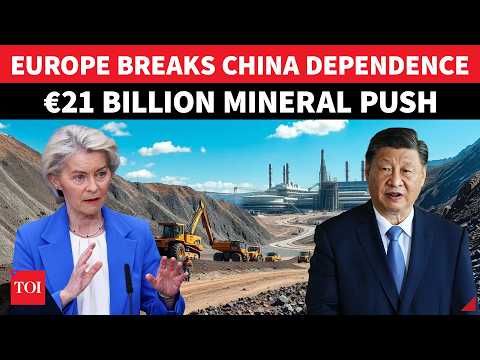
The European Commission approved 46 projects on October 9 to mine, process, and recycle critical minerals inside the EU. They need roughly €21.1 billion ($23.7 billion) in investment and span 16 member states, from a battery recycling plant in Romania to a rare earths facility in southwestern France.

Europe imports most of these minerals, and China dominates supply of several — including rare earths, which it has restricted for export since 2023. The selection is the second under the EU's 2024 Critical Raw Materials Act, bringing the total to 93 EU projects aimed at meeting targets of 10% domestic extraction, 40% processing, and 25% recycling by 2030.

Why it matters

If these projects stall, Europe's battery, defense, and renewable industries stay dependent on Chinese minerals China has already restricted.

Questions about this story

Free account needed to ask — your question is kept and asked for you right after sign-up. Answers are public.

No questions yet — be the first to ask.

Key Indicators

46
New EU strategic projects
Second selection round under the Critical Raw Materials Act, approved October 9, 2026.
$23.7B
Estimated capital investment required
The Commission estimates €21.1 billion in combined public and private funding for the 46 projects.
93
Total EU strategic projects
Combined first (47) and second (46) lists of strategic projects inside the EU.
$2.24B
Public funding already mobilized
Raised for 2025 selections through the Innovation Fund, State aid, and the European Investment Bank.

Voices

Curated perspectives — historical figures and your fellow readers.

Ever wondered what historical figures would say about today's headlines?

Sign up to generate historical perspectives on this story.

People Involved

Organizations Involved

Timeline

May 2024 October 2026

5 events Latest: October 9th, 2026 · 1 week ago
Tap a bar to jump to that date
  1. Commission approves 46 new strategic projects

    Latest Policy

    Second EU list spans 16 member states, covering 15 of 17 strategic materials, with 8 extraction, 11 processing, 19 recycling, and 8 integrated projects.

  2. Commission opens second call for projects

    Announcement

    Launch of the second application round for strategic project status.

  3. 13 strategic projects approved in third countries

    Policy

    Strategic projects selected outside the EU and in overseas territories to diversify supply.

  4. First 47 EU strategic projects approved

    Policy

    First selection round designates projects across the EU under the new framework.

  5. EU adopts Critical Raw Materials Act

    Legislation

    Sets 2030 targets to extract 10%, process 40%, and recycle 25% of strategic mineral needs domestically.

Scenarios

1

EU mineral projects break ground by 2028

Possible Resolves by End of 2028

Discussed by: European Commission, which has mobilized over €2 billion for prior selections and says the designation attracts investors

Faster permitting and EU funding facilitation pull in private capital. Projects like the Carester plant near Pau come online and the EU moves toward its 2030 processing target. Commission officials note strategic status is often seen as more attractive to investors because it certifies technical feasibility and sustainability.

2

Funding shortfall strands EU mineral projects

Possible Resolves by End of 2027

Discussed by: Project developers, who warned in August 2026 that more projects could fail without urgent funding

Strategic status does not guarantee money, and the roughly $23.7 billion needed must come mostly from private investors. Progress on the 2025 selections has been slow, with some struggling to advance. If EU funding instruments and state aid don't scale up, projects get delayed or canceled despite regulatory backing.

3

China trade war accelerates EU mineral buildup

Possible Resolves by Q2 2027

Discussed by: Stéphane Séjourné, who framed the selection as fending off a potential trade crisis with China

Further Chinese export restrictions on critical minerals push EU member states to fast-track projects, allocate more state aid, and treat mineral self-sufficiency as a security priority. The Commission has already cited China's 2023 gallium and germanium restrictions in justifying the program.

Historical Context

3 moments from history that rhyme with this story — and how they unfolded.

September 2010

China-Japan rare earths dispute (2010)

After a Chinese fishing boat collided with Japanese coast guard vessels near disputed islands, China halted rare earth exports to Japan. Global prices for the minerals tripled within months, exposing how concentrated supply had become.

Then

Japan stockpiled rare earths, sped up recycling, and negotiated alternative suppliers, while manufacturers scrambled for substitutes.

Now

The episode forced governments worldwide to treat rare earth supply as a strategic vulnerability rather than a market commodity.

Why this matters now

It showed what happens when a dominant supplier weaponizes mineral exports — the exact scenario the EU's Critical Raw Materials Act is designed to prevent.

August 2022

U.S. CHIPS and Science Act (2022)

After pandemic-era shortages and growing concentration of semiconductor manufacturing in Asia, the U.S. passed a $52 billion law to subsidize domestic chip fabrication and research.

Then

Major chipmakers announced new U.S. fabrication plants, though construction and workforce challenges have slowed progress.

Now

Set a template for Western governments using subsidies and regulatory fast-tracking to reshore critical supply chains.

Why this matters now

The EU's strategic project designation works on the same logic as the CHIPS Act — using policy levers to rebuild domestic capacity in a sector where dependence proved dangerous.

October 1973

1973 oil embargo

Arab oil producers cut exports to countries supporting Israel during the Yom Kippur War. Oil prices quadrupled and Western economies plunged into recession.

Then

The U.S. and Europe imposed fuel rationing, speed limits, and created strategic petroleum reserves.

Now

Energy security became a permanent pillar of Western policy, and the embargo remains the reference point for supply-cutoff risk.

Why this matters now

It is the classic case of import dependence becoming a foreign policy lever — the same risk Europe now faces with critical minerals, which are the oil of clean energy and defense.

Sources

(9)